Written by Bryan Nelson
The current rate of extinction is 100 to 1000 times higher than the average, or background rate, making our current period the 6th major mass extinction in the planet’s history.
Although fossil reconstructions or pictorial representations can sometimes be difficult to connect with, it’s impossible to ignore the experience of seeing a photograph of an animal on the brink of extinction.
Thus, what follows is a list of 11 extinct animals that were photographed while still alive.
Tasmanian Tiger
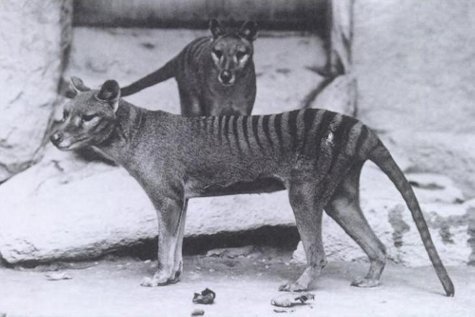
The last Tasmanian Tiger, or Thylacine, known to have existed died in the Hobart Zoo, in Tasmania, Australia, on September 7th, 1936. Despite being the last of its kind, the animal (named “Benjamin”) likely died due to neglect after being locked out of its sheltered quarters during extreme weather.
Although commonly referred to as ‘tigers’, and despite having the look of a canid, the Thylacine isn’t remotely related to cats or dogs. Rather, it was the largest carnivorous marsupial of modern times, meaning it carried its young in a pouch. Its closest living relative is the Tasmanian Devil.
The biggest cause of their extinction in the wild was a massive hunting campaign instituted by the Tasmanian government from 1888 to 1909, justified because the Thylacines were believed to be a threat to sheep and hens. The last known wild Tasmanian Tiger was killed by a farmer named Wilf Batty in 1930, after spotting the animal around his hen house.
Quagga
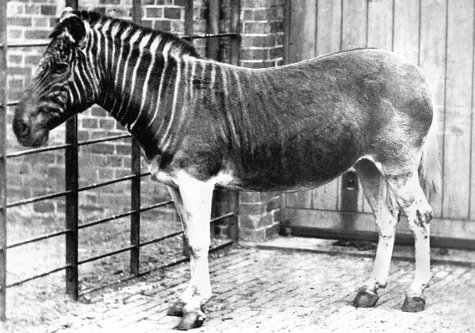
The Quagga was a unique variety of Plains Zebra, marked by having stripes only on the front of its body, with hair color transitioning toward a light brown or tan along its rear and underbelly, until becoming white along its legs. This picture represents the only Quagga ever to have been photographed alive, taken at the London Zoo in 1870.
Its unique hide made the Quagga a target for hunters and poachers, and the last known wild Quagga was probably killed in the late 1870’s. The species went extinct on August 12th, 1883, when the last specimen died at a zoo in Amsterdam, The Netherlands.
Passenger Pigeon
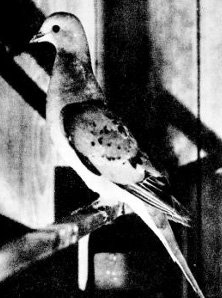 The story of the Passenger Pigeon is one of the most tragic extinction stories in modern times. As recently as around 200 years ago they weren’t anywhere near extinction. In fact, they were actually the most common bird in North America, and some reports counted single flocks numbering in the billions.
During some migrations, the flocks flying overhead would stretch for over a mile and could take several hours to pass. It would have been impossible to imagine a North American skyline without them. Yet somehow the species went from being one of the most abundant birds in the world to extinction in only about 100 years. What happened?
Colonial hunters happened. The pigeon meat was commercialized and recognized as cheap food, especially for slaves and the poor, which led to a catastrophic hunting campaign on a massive scale. Furthermore, due to the large size of their flocks, the birds were seen as a threat to farmers. In fact, in 1703 the Catholic bishop of Quebec actually excommunicated the entire species.
The last known Passenger Pigeon, named “Martha”, died in captivity on September 1st, 1914, in Cincinnati, Ohio. In 1896, the last flock of 250,000 birds were slaughtered by hunters despite the knowledge that it was the last flock of that size left.
Golden Toad

The first recorded account of the Golden Toad was by herpetologist Jay Savage in 1966, and the last sighting of the species was made in 1989. The toad, showcased by its brilliant golden orange colorization, was native to the tropical cloud forests which surround Monteverde, Costa Rica.
Their extinction symbolizes a large scale decline in amphibian numbers worldwide over the last several decades, which has likely been caused by global warming and climate change. In fact, famed Australian biologist Tim Flannery has described the extinction of the Golden Toad to be the first demise of a species due primarily to global warming.
Caribbean Monk Seal
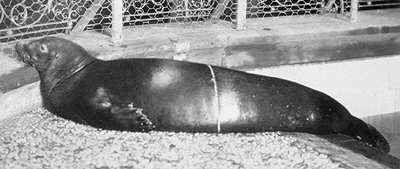
The Caribbean Monk Seal was the only known seal which was native to the Caribbean Sea and the Gulf of Mexico. It is also the only species of seal to go extinct directly due to human causes. It was officially declared extinct just last year, on June 6th, 2008, although the last recorded account of the species was made at Serranilla Bank between Honduras and Jamaica in 1952.
Their eventual demise, brought on by human hunting, was symbolized during Columbus’ 1494 voyage, when the tiny seals were described as “sea wolves” and 8 were recorded to have been killed and slaughtered for their meat.
Pyrenean Ibex

The Pyrenean Ibex has one of the more interesting stories among extinct animals, since it was the first species to ever be brought back into existence via cloning, only to go extinct again just seven minutes after being born due to lung failure. Here at Ecoworldly, we reported on the event, which happened in January 2009.
The last naturally born Pyrenean Ibex died on January 6th, 2000, after being found dead under a fallen tree at the age of 13. That animal’s only companion had died just a year earlier due to old age. Although the recent effort to resurrect the Ibex was short-lived, the event does bring optimism, and raise serious debate, about whether extinct creatures should be given a second chance.
Bubal Hartebeest

The Bubal Hartebeest was a magnificent, tough beast which was once domesticated by the ancient Egyptians as a food source and for sacrificial purposes. The creature was even mentioned in the Old Testament.
Although it once roamed throughout Northern Africa and the Middle East, the deep-rooted mythology which surrounded the animal was not enough to save it from European hunters who began hunting them for recreation and meat. The last Bubal Hartebeest was probably a female which died in the Paris Zoo in 1923.
Javan Tiger
 Javan Tigers are a subspecies of tiger which were limited to the Indonesian island of Java. The last specimen to have been seen was sighted in 1972, although there is evidence from track counts that the animal had lingered into the 1980’s. The last track counts to yield evidence of the tigers was held in 1979, when just three tigers were identified.
The leading cause of their extinction was agricultural encroachment and habitat loss, which continues to be a serious concern in Java.
There are some who believe that Javan Tigers could still be alive in some of the island’s few remaining forested regions, although even so, the tiger’s numbers would be so low that the species would still be functionally extinct. The region most likely to contain a tiger today would have to be the Meru Betiri National Park, although even that area is now being threatened by mining companies after the discovery of gold nearby.
Tecopa Pupfish

The Tecopa Pupfish has the unfortunate distinction of being the first species to be declared extinct under the Endangered Species Act of 1973. The official de-listing of the animal came in 1981.
The fish were first discovered in the Tecopa Hot Springs in California in 1942, and their decline followed shortly thereafter, as the Hot Springs were canalized and replaced with bathhouses. The final nail in the coffin came when hotels and trailer parks were built nearby to allow for more comfortable recreation for tourists.
Syrian Wild Ass

The Syrian Wild Ass was likely extinct when the last known captive animal died at the Schönbrunn Zoo in Vienna, Austria, in 1928. It once had a wide range throughout Mesopotamia, where reports were common of large herds which used to roam wildly in the mountains and desert steppes of the Middle East.
Although already threatened beforehand, it is said that the Syrian Wild Ass completely collapsed during World War I, when their habitat was overrun with heavily armed Turkish and British troops. One account remarked that “it could not resist the power of the modern guns in the hands of the Anazeh and Shammar nomads, and its speed, great as it may have been, was not sufficient always to escape from the velocity of the modern motor car which more and more is replacing the Old Testament Camel-Caravan.”
Baiji River Dolphin

The inevitable appears to have arrived for the Baiji River Dolphin, a peaceful, majestic dolphin which had inhabited China’s Yangtze River for at least the last 20 million years. The dolphin was declared functionally extinct after an expedition late in 2006 failed to record a single individual after an extensive search of the animal’s entire range.
Although unconfirmed sightings have come out since then, it’s unlikely that any living individuals, should they still exist, would be able find each other and breed. This tragic demise makes the Baiji Dolphin the first recorded extinction of a cetacean in modern times.
The population had been declining rapidly in recent decades since the rise of Chinese industrialization, which has utilized the Yangtze River as one of its primary arteries. The river is now one of the worst polluted major waterways in the world, being heavily relied upon for transportation and hydroelectricity. Roughly 12% of the world’s human population lives and works within the river’s catchment zone.
Traditional Chinese tales refer to the Baiji as a symbol of peace and prosperity. However, that traditional veneration was denounced during China’s “Great Leap Forward”, which called for hunting the animal in the name of redefining Chinese prosperity.
Regrettably, the Chinese may have got what they called for. Now that the dolphin is extinct, it’s difficult to avoid drowning the kind of prosperity it once symbolized along with it.
Image Credits: Ibex photo by José M. Gómez under the GNU Free Documentation License; Baiji Dolphin photo copyright by the baiji.org foundation, Steven Leatherwood; All other images are public domain via Wiki Commons

Nice one!
thanks
i was in school looking at this lising to music that was sad it was good but soo sadd(the seasons come and go but i will never chang i used to be the kid that nobdey cares about but i jus juss sreaming till they hear me out) we should make a endangerd spiesis comershals with that song
While you’re in school you should learn how to spell.
Some people have a hard time with spellin so a fat dick u cunt
did u make this site
This is an amazing article, great work!
oh wow.
The knowledge that the extinction of almost all of the 11 animals has been brought about by us humans is immensely sad and disturbing. It proves once again the blatant disregard many humans have towards animals. When are we going to learn that animals are living beings just like us and that we have absolutely no right to hunt and kill them for reasons as stupid as pleasure and entertainment??? Shame on us humans.
wow i would think that someone would try doin something!why isnt anybody doing anyhting our grandchildren will live in a world where no animal exist!there are more endangered animals in captivity than in hte wild!the amount of all the tigers in the world i s equal to what used to the number of just one species!!!!it rlly hurts o me to see this happening and man cantr someone do somehting mate tigers in the wild with tigers in captivity,release the cubs when grown and repeat the process over with other tigers
and do the same with other endangered species bcuz it rlly hurts my feelings to see this happening!!and then i see hunters soo proud of what they got and i wish i could hang there head on the wall instead of the deers!!i bet thats what the deer want cuz they are like us!and gosh i have feelings this stronng and im only 13
balls yes-im a vegetarian i agree
hi
i wish they weren’t extinct
how sad
tasie tigers are still around. in smithton 2 tigers killed 3 dogs i can prove it
This is just sad. All of these animals were killed off by humans. Oh, by the way, please see our Wikispace on endangered animals at http://helpanimalsnow.wikispaces.com.
those are sad exstintions
i feel so sad for the extict animals and i am the gayest peson in the world
for get im gaye i was joking around
omg those animals are cute!!!!!!
but it didnt help me in my essaey on animal extiction!!!!!
im sleepy!!!
poor animals i feel sad!!!!
I also say those animals are cute and jilly you are pore pethetic LOSER
Its too bad that people back in the day didn’t have the same morals as we do now days. It seems that if these cases were in the year 2009 we wouldn’t allow it to come to extinction- but maybe considering all the animals that are becoming extinct- I totally support cloning in these cases due to it not being their fault there extinct- its OURS!! So Sad:(
your mean bubblebut!!!!!!! what kind of name is that!!!!! and those stories are sad!!!!! i take it back this has really helped me do my essay!!!!!YAY!!!!
oh and bubblebut learn how to spell!!!!!! thats not how you spell poor!!!!
FUCK ME
thanks for your information because i didnt know that there is such animals in da world
fuk u 2 and suck mi dick u ass
damn…whats wrong with us….
SAD 🙁
Nic u r a tosser
it is very good
I love how people think that it’s not them causing this. They think as extinct animals as being killed by “bad people”. Or they think that in our modern age we could avoid this. It’s everyone, Industry destroys the world. Industries that are created to support our unthinkable population. A planet that can balance 500 million humans is polluted with 6.7 Billion? Is that not absurd? Do you think we are traveling in the right direction? Blindly following a government in this black abyss of life. Extinction will continue until humans are extinct, which will be soon.
I am appalled by the confirmation of the extinction of these photographed of11 extinct animals. This generation and the next succeeding generations could have enjoyed seeing them alive. But because of some unscrupulous individuals, Their right to live and our right to enjoy them so with the next generations were stripped off. It is my firm conviction that we have no right to drive any specie on this planet to extinction. I believe that their destruction greatly affects our human existence.
I am appalled by the confirmation of the extinction of these 11 photographed extinct animals. This generation and the next succeeding generations could have enjoyed seeing them alive. But because of some unscrupulous individuals, Their right to live and our right to enjoy them so with the next generations were stripped off. It is my firm conviction that we have no right to drive any specie on this planet to extinction. I believe that their destruction greatly affects our human existence.
I don’t think all of these are accurate. For example, I just shot an Ibex last weekend.
jilly is a bitch!!!! who uses way to many!!!! to express!!!! her fucked up!!!! opinions!!!!!!!
My GOD, how can I or anyone else look at these pictures of the
beautiful creation and not cry. It is said that we should learn from our
mistakes, but have we. Our world is losing the beautiful souds and
sights so quickly that if you blink you might just miss out on it!
There are animals that are mentioned in the bible that neither I or
my children will ever see on this planet. We are resonsible for the lost
of all the great and wonderful things that were put her for us to take
care of, nurture and watch over. Why is it that humans can’t realize
the importance of something until it’s gone.
From the looks of things, we won’t have much time to enjoy the
plants, flowers, animals, rivers or oceans. All I can say is that if the
world is destined to be a barened waiste land, then I pray that it
dosen’t last long enough to suffer that inevidale fate.
GOD Bless!
im feel so bad for those animals i know im craaaaazy for animals
nice animals
I dont think it makes any sense to categories the Javen Tiger as extinct b/c there are possibilities that it still exists in some part of Java.
shame poor pigeons!!
H.w >_>
i am doing a school health project about extincted animals so i am glad they have these pictures
we are doing a reaserch program and everything i need is right here!
this web is great for my homework luv it
My GOD, how can I or anyone else look at these pictures of the
beautiful creation and not cry. It is said that we should learn from our
mistakes, but have we. Our world is losing the beautiful souds and
sights so quickly that if you blink you might just miss out on it!
There are animals that are mentioned in the bible that neither I or
my children will ever see on this planet. We are resonsible for the lost
of all the great and wonderful things that were put her for us to take
care of, nurture and watch over. Why is it that humans can’t realize
the importance of something until it’s gone.
From the looks of things, we won’t have much time to enjoy the
plants, flowers, animals, rivers or oceans. All I can say is that if the
world is destined to be a barened waiste land, then I pray that it
dosen’t last long enough to suffer that inevidale fate.
GOD Bless!
________________________________________________________
lol wot a load not crap lol its just weird
this didnt help me at all!!!oh well gotta go back to google 🙁
Hey, at least it wasn’t puppies! Woot!
i want almost extinct animals with it reason .
This is very sad. I agree with most of you, who have taken this seriously. This is a huge problem and it is entirely the human species fault. This is a problem that is often overlooked and even more often made fun of. People who have the balls to make fun of dire problems have no right to live themselves. People who can only make smart ass remarks about websites should stay were they belong, in their parents basement, sucking on their mothers tit like they have their entire lives. What gives us the right, as humans to kill what we want? Why is it ok to kill an animal for its fur? One day it may be us, we may lose the spot as the dominant species and be hunted for our skin. For everyone who does not take this seriously, fuck off, but for everybody who does please try to convince people around you that this is a serious problem.
Well what in the hell did these animals did fer us y’all?? I neever heard of any tiger helping out a man or any damn dolphin thing saving a drowning soul. So kill em all I say.I dont but whosoever wants can do coz I gives a damn if only humans r there. Heheh I say we are all animals aint we???
Wow i wish I was alive to see one of those passanger pigons flock a mile long
ko pahal
human beings are scum of the earth. And Whoever this ‘death’ person is they should be tortured and skinned alive for having that attitude. If it weren’t for humans, so many beautiful animals and other things would be around today. I wish humans were extinct.
sad 🙁 very very sad 🙁
Madame Speaker, Vice President Biden, Members of Congress, distinguished guests, and fellow Americans:
Our Constitution declares that from time to time, the President shall give to Congress information about the state of our union. For two hundred and twenty years, our leaders have fulfilled this duty. They have done so during periods of prosperity and tranquility. And they have done so in the midst of war and depression; at moments of great strife and great struggle.
It’s tempting to look back on these moments and assume that our progress was inevitable – that America was always destined to succeed. But when the Union was turned back at Bull Run and the Allies first landed at Omaha Beach, victory was very much in doubt. When the market crashed on Black Tuesday and civil rights marchers were beaten on Bloody Sunday, the future was anything but certain. These were times that tested the courage of our convictions, and the strength of our union. And despite all our divisions and disagreements; our hesitations and our fears; America prevailed because we chose to move forward as one nation, and one people.
Again, we are tested. And again, we must answer history’s call.
One year ago, I took office amid two wars, an economy rocked by severe recession, a financial system on the verge of collapse, and a government deeply in debt. Experts from across the political spectrum warned that if we did not act, we might face a second depression. So we acted – immediately and aggressively. And one year later, the worst of the storm has passed.
But the devastation remains. One in ten Americans still cannot find work. Many businesses have shuttered. Home values have declined. Small towns and rural communities have been hit especially hard. For those who had already known poverty, life has become that much harder.
This recession has also compounded the burdens that America’s families have been dealing with for decades – the burden of working harder and longer for less; of being unable to save enough to retire or help kids with college.
So I know the anxieties that are out there right now. They’re not new. These struggles are the reason I ran for President. These struggles are what I’ve witnessed for years in places like Elkhart, Indiana and Galesburg, Illinois. I hear about them in the letters that I read each night. The toughest to read are those written by children – asking why they have to move from their home, or when their mom or dad will be able to go back to work.
For these Americans and so many others, change has not come fast enough. Some are frustrated; some are angry. They don’t understand why it seems like bad behavior on Wall Street is rewarded but hard work on Main Street isn’t; or why Washington has been unable or unwilling to solve any of our problems. They are tired of the partisanship and the shouting and the pettiness. They know we can’t afford it. Not now.
So we face big and difficult challenges. And what the American people hope – what they deserve – is for all of us, Democrats and Republicans, to work through our differences; to overcome the numbing weight of our politics. For while the people who sent us here have different backgrounds, different stories and different beliefs, the anxieties they face are the same. The aspirations they hold are shared. A job that pays the bills. A chance to get ahead. Most of all, the ability to give their children a better life.
You know what else they share? They share a stubborn resilience in the face of adversity. After one of the most difficult years in our history, they remain busy building cars and teaching kids; starting businesses and going back to school. They’re coaching little league and helping their neighbors. As one woman wrote me, “We are strained but hopeful, struggling but encouraged.”
It is because of this spirit – this great decency and great strength – that I have never been more hopeful about America’s future than I am tonight. Despite our hardships, our union is strong. We do not give up. We do not quit. We do not allow fear or division to break our spirit. In this new decade, it’s time the American people get a government that matches their decency; that embodies their strength.
And tonight, I’d like to talk about how together, we can deliver on that promise.
It begins with our economy.
Our most urgent task upon taking office was to shore up the same banks that helped cause this crisis. It was not easy to do. And if there’s one thing that has unified Democrats and Republicans, it’s that we all hated the bank bailout. I hated it. You hated it. It was about as popular as a root canal.
But when I ran for President, I promised I wouldn’t just do what was popular – I would do what was necessary. And if we had allowed the meltdown of the financial system, unemployment might be double what it is today. More businesses would certainly have closed. More homes would have surely been lost.
So I supported the last administration’s efforts to create the financial rescue program. And when we took the program over, we made it more transparent and accountable. As a result, the markets are now stabilized, and we have recovered most of the money we spent on the banks.
To recover the rest, I have proposed a fee on the biggest banks. I know Wall Street isn’t keen on this idea, but if these firms can afford to hand out big bonuses again, they can afford a modest fee to pay back the taxpayers who rescued them in their time of need.
As we stabilized the financial system, we also took steps to get our economy growing again, save as many jobs as possible, and help Americans who had become unemployed.
That’s why we extended or increased unemployment benefits for more than 18 million Americans; made health insurance 65% cheaper for families who get their coverage through COBRA; and passed 25 different tax cuts.
Let me repeat: we cut taxes. We cut taxes for 95% of working families. We cut taxes for small businesses. We cut taxes for first-time homebuyers. We cut taxes for parents trying to care for their children. We cut taxes for 8 million Americans paying for college. As a result, millions of Americans had more to spend on gas, and food, and other necessities, all of which helped businesses keep more workers. And we haven’t raised income taxes by a single dime on a single person. Not a single dime.
Because of the steps we took, there are about two million Americans working right now who would otherwise be unemployed. 200,000 work in construction and clean energy. 300,000 are teachers and other education workers. Tens of thousands are cops, firefighters, correctional officers, and first responders. And we are on track to add another one and a half million jobs to this total by the end of the year.
The plan that has made all of this possible, from the tax cuts to the jobs, is the Recovery Act. That’s right – the Recovery Act, also known as the Stimulus Bill. Economists on the left and the right say that this bill has helped saved jobs and avert disaster. But you don’t have to take their word for it.
Talk to the small business in Phoenix that will triple its workforce because of the Recovery Act.
Talk to the window manufacturer in Philadelphia who said he used to be skeptical about the Recovery Act, until he had to add two more work shifts just because of the business it created.
Talk to the single teacher raising two kids who was told by her principal in the last week of school that because of the Recovery Act, she wouldn’t be laid off after all.
There are stories like this all across America. And after two years of recession, the economy is growing again. Retirement funds have started to gain back some of their value. Businesses are beginning to invest again, and slowly some are starting to hire again.
But I realize that for every success story, there are other stories, of men and women who wake up with the anguish of not knowing where their next paycheck will come from; who send out resumes week after week and hear nothing in response. That is why jobs must be our number one focus in 2010, and that is why I am calling for a new jobs bill tonight.
Now, the true engine of job creation in this country will always be America’s businesses. But government can create the conditions necessary for businesses to expand and hire more workers.
We should start where most new jobs do – in small businesses, companies that begin when an entrepreneur takes a chance on a dream, or a worker decides its time she became her own boss.
Through sheer grit and determination, these companies have weathered the recession and are ready to grow. But when you talk to small business owners in places like Allentown, Pennsylvania or Elyria, Ohio, you find out that even though banks on Wall Street are lending again, they are mostly lending to bigger companies. But financing remains difficult for small business owners across the country.
So tonight, I’m proposing that we take $30 billion of the money Wall Street banks have repaid and use it to help community banks give small businesses the credit they need to stay afloat. I am also proposing a new small business tax credit – one that will go to over one million small businesses who hire new workers or raise wages. While we’re at it, let’s also eliminate all capital gains taxes on small business investment; and provide a tax incentive for all businesses, large and small, to invest in new plants and equipment.
Next, we can put Americans to work today building the infrastructure of tomorrow. From the first railroads to the interstate highway system, our nation has always been built to compete. There’s no reason Europe or China should have the fastest trains, or the new factories that manufacture clean energy products.
Tomorrow, I’ll visit Tampa, Florida, where workers will soon break ground on a new high-speed railroad funded by the Recovery Act. There are projects like that all across this country that will create jobs and help our nation move goods, services, and information. We should put more Americans to work building clean energy facilities, and give rebates to Americans who make their homes more energy efficient, which supports clean energy jobs. And to encourage these and other businesses to stay within our borders, it’s time to finally slash the tax breaks for companies that ship our jobs overseas and give those tax breaks to companies that create jobs in the United States of America.
The House has passed a jobs bill that includes some of these steps. As the first order of business this year, I urge the Senate to do the same. People are out of work. They are hurting. They need our help. And I want a jobs bill on my desk without delay.
But the truth is, these steps still won’t make up for the seven million jobs we’ve lost over the last two years. The only way to move to full employment is to lay a new foundation for long-term economic growth, and finally address the problems that America’s families have confronted for years.
We cannot afford another so-called economic “expansion” like the one from last decade – what some call the “lost decade” – where jobs grew more slowly than during any prior expansion; where the income of the average American household declined while the cost of health care and tuition reached record highs; where prosperity was built on a housing bubble and financial speculation.
From the day I took office, I have been told that addressing our larger challenges is too ambitious – that such efforts would be too contentious, that our political system is too gridlocked, and that we should just put things on hold for awhile.
For those who make these claims, I have one simple question:
How long should we wait? How long should America put its future on hold?
You see, Washington has been telling us to wait for decades, even as the problems have grown worse. Meanwhile, China’s not waiting to revamp its economy. Germany’s not waiting. India’s not waiting. These nations aren’t standing still. These nations aren’t playing for second place. They’re putting more emphasis on math and science. They’re rebuilding their infrastructure. They are making serious investments in clean energy because they want those jobs.
Well I do not accept second-place for the United States of America. As hard as it may be, as uncomfortable and contentious as the debates may be, it’s time to get serious about fixing the problems that are hampering our growth.
One place to start is serious financial reform. Look, I am not interested in punishing banks, I’m interested in protecting our economy. A strong, healthy financial market makes it possible for businesses to access credit and create new jobs. It channels the savings of families into investments that raise incomes. But that can only happen if we guard against the same recklessness that nearly brought down our entire economy.
We need to make sure consumers and middle-class families have the information they need to make financial decisions. We can’t allow financial institutions, including those that take your deposits, to take risks that threaten the whole economy.
The House has already passed financial reform with many of these changes. And the lobbyists are already trying to kill it. Well, we cannot let them win this fight. And if the bill that ends up on my desk does not meet the test of real reform, I will send it back.
Next, we need to encourage American innovation. Last year, we made the largest investment in basic research funding in history – an investment that could lead to the world’s cheapest solar cells or treatment that kills cancer cells but leaves healthy ones untouched. And no area is more ripe for such innovation than energy. You can see the results of last year’s investment in clean energy – in the North Carolina company that will create 1200 jobs nationwide helping to make advanced batteries; or in the California business that will put 1,000 people to work making solar panels.
But to create more of these clean energy jobs, we need more production, more efficiency, more incentives. That means building a new generation of safe, clean nuclear power plants in this country. It means making tough decisions about opening new offshore areas for oil and gas development. It means continued investment in advanced biofuels and clean coal technologies. And yes, it means passing a comprehensive energy and climate bill with incentives that will finally make clean energy the profitable kind of energy in America.
I am grateful to the House for passing such a bill last year. This year, I am eager to help advance the bipartisan effort in the Senate. I know there have been questions about whether we can afford such changes in a tough economy; and I know that there are those who disagree with the overwhelming scientific evidence on climate change. But even if you doubt the evidence, providing incentives for energy efficiency and clean energy are the right thing to do for our future – because the nation that leads the clean energy economy will be the nation that leads the global economy. And America must be that nation.
Third, we need to export more of our goods. Because the more products we make and sell to other countries, the more jobs we support right here in America. So tonight, we set a new goal: We will double our exports over the next five years, an increase that will support two million jobs in America. To help meet this goal, we’re launching a National Export Initiative that will help farmers and small businesses increase their exports, and reform export controls consistent with national security.
We have to seek new markets aggressively, just as our competitors are. If America sits on the sidelines while other nations sign trade deals, we will lose the chance to create jobs on our shores. But realizing those benefits also means enforcing those agreements so our trading partners play by the rules. And that’s why we will continue to shape a Doha trade agreement that opens global markets, and why we will strengthen our trade relations in Asia and with key partners like South Korea, Panama, and Colombia.
Fourth, we need to invest in the skills and education of our people.
This year, we have broken through the stalemate between left and right by launching a national competition to improve our schools. The idea here is simple: instead of rewarding failure, we only reward success. Instead of funding the status quo, we only invest in reform – reform that raises student achievement, inspires students to excel in math and science, and turns around failing schools that steal the future of too many young Americans, from rural communities to inner-cities. In the 21st century, one of the best anti-poverty programs is a world-class education. In this country, the success of our children cannot depend more on where they live than their potential.
When we renew the Elementary and Secondary Education Act, we will work with Congress to expand these reforms to all fifty states. Still, in this economy, a high school diploma no longer guarantees a good job. I urge the Senate to follow the House and pass a bill that will revitalize our community colleges, which are a career pathway to the children of so many working families. To make college more affordable, this bill will finally end the unwarranted taxpayer-subsidies that go to banks for student loans. Instead, let’s take that money and give families a $10,000 tax credit for four years of college and increase Pell Grants. And let’s tell another one million students that when they graduate, they will be required to pay only ten percent of their income on student loans, and all of their debt will be forgiven after twenty years – and forgiven after ten years if they choose a career in public service. Because in the United States of America, no one should go broke because they chose to go to college. And it’s time for colleges and universities to get serious about cutting their own costs – because they too have a responsibility to help solve this problem.
Now, the price of college tuition is just one of the burdens facing the middle-class. That’s why last year I asked Vice President Biden to chair a task force on Middle-Class Families. That’s why we’re nearly doubling the child care tax credit, and making it easier to save for retirement by giving every worker access to a retirement account and expanding the tax credit for those who start a nest egg. That’s why we’re working to lift the value of a family’s single largest investment – their home. The steps we took last year to shore up the housing market have allowed millions of Americans to take out new loans and save an average of $1,500 on mortgage payments. This year, we will step up re-financing so that homeowners can move into more affordable mortgages. And it is precisely to relieve the burden on middle-class families that we still need health insurance reform.
Now let’s be clear – I did not choose to tackle this issue to get some legislative victory under my belt. And by now it should be fairly obvious that I didn’t take on health care because it was good politics.
I took on health care because of the stories I’ve heard from Americans with pre-existing conditions whose lives depend on getting coverage; patients who’ve been denied coverage; and families – even those with insurance – who are just one illness away from financial ruin.
After nearly a century of trying, we are closer than ever to bringing more security to the lives of so many Americans. The approach we’ve taken would protect every American from the worst practices of the insurance industry. It would give small businesses and uninsured Americans a chance to choose an affordable health care plan in a competitive market. It would require every insurance plan to cover preventive care. And by the way, I want to acknowledge our First Lady, Michelle Obama, who this year is creating a national movement to tackle the epidemic of childhood obesity and make our kids healthier.
Our approach would preserve the right of Americans who have insurance to keep their doctor and their plan. It would reduce costs and premiums for millions of families and businesses. And according to the Congressional Budget Office – the independent organization that both parties have cited as the official scorekeeper for Congress – our approach would bring down the deficit by as much as $1 trillion over the next two decades.
Still, this is a complex issue, and the longer it was debated, the more skeptical people became. I take my share of the blame for not explaining it more clearly to the American people. And I know that with all the lobbying and horse-trading, this process left most Americans wondering what’s in it for them.
But I also know this problem is not going away. By the time I’m finished speaking tonight, more Americans will have lost their health insurance. Millions will lose it this year. Our deficit will grow. Premiums will go up. Patients will be denied the care they need. Small business owners will continue to drop coverage altogether. I will not walk away from these Americans, and neither should the people in this chamber.
As temperatures cool, I want everyone to take another look at the plan we’ve proposed. There’s a reason why many doctors, nurses, and health care experts who know our system best consider this approach a vast improvement over the status quo. But if anyone from either party has a better approach that will bring down premiums, bring down the deficit, cover the uninsured, strengthen Medicare for seniors, and stop insurance company abuses, let me know. Here’s what I ask of Congress, though: Do not walk away from reform. Not now. Not when we are so close. Let us find a way to come together and finish the job for the American people.
Now, even as health care reform would reduce our deficit, it’s not enough to dig us out of a massive fiscal hole in which we find ourselves. It’s a challenge that makes all others that much harder to solve, and one that’s been subject to a lot of political posturing.
So let me start the discussion of government spending by setting the record straight. At the beginning of the last decade, America had a budget surplus of over $200 billion. By the time I took office, we had a one year deficit of over $1 trillion and projected deficits of $8 trillion over the next decade. Most of this was the result of not paying for two wars, two tax cuts, and an expensive prescription drug program. On top of that, the effects of the recession put a $3 trillion hole in our budget. That was before I walked in the door.
Now if we had taken office in ordinary times, I would have liked nothing more than to start bringing down the deficit. But we took office amid a crisis, and our efforts to prevent a second Depression have added another $1 trillion to our national debt.
I am absolutely convinced that was the right thing to do. But families across the country are tightening their belts and making tough decisions. The federal government should do the same. So tonight, I’m proposing specific steps to pay for the $1 trillion that it took to rescue the economy last year.
Starting in 2011, we are prepared to freeze government spending for three years. Spending related to our national security, Medicare, Medicaid, and Social Security will not be affected. But all other discretionary government programs will. Like any cash-strapped family, we will work within a budget to invest in what we need and sacrifice what we don’t. And if I have to enforce this discipline by veto, I will.
We will continue to go through the budget line by line to eliminate programs that we can’t afford and don’t work. We’ve already identified $20 billion in savings for next year. To help working families, we will extend our middle-class tax cuts. But at a time of record deficits, we will not continue tax cuts for oil companies, investment fund managers, and those making over $250,000 a year. We just can’t afford it.
Now, even after paying for what we spent on my watch, we will still face the massive deficit we had when I took office. More importantly, the cost of Medicare, Medicaid, and Social Security will continue to skyrocket. That’s why I’ve called for a bipartisan, Fiscal Commission, modeled on a proposal by Republican Judd Gregg and Democrat Kent Conrad. This can’t be one of those Washington gimmicks that lets us pretend we solved a problem. The Commission will have to provide a specific set of solutions by a certain deadline. Yesterday, the Senate blocked a bill that would have created this commission. So I will issue an executive order that will allow us to go forward, because I refuse to pass this problem on to another generation of Americans. And when the vote comes tomorrow, the Senate should restore the pay-as-you-go law that was a big reason why we had record surpluses in the 1990s.
I know that some in my own party will argue that we cannot address the deficit or freeze government spending when so many are still hurting. I agree, which is why this freeze will not take effect until next year, when the economy is stronger. But understand – if we do not take meaningful steps to rein in our debt, it could damage our markets, increase the cost of borrowing, and jeopardize our recovery – all of which could have an even worse effect on our job growth and family incomes.
From some on the right, I expect we’ll hear a different argument – that if we just make fewer investments in our people, extend tax cuts for wealthier Americans, eliminate more regulations, and maintain the status quo on health care, our deficits will go away. The problem is, that’s what we did for eight years. That’s what helped lead us into this crisis. It’s what helped lead to these deficits. And we cannot do it again.
Rather than fight the same tired battles that have dominated Washington for decades, it’s time to try something new. Let’s invest in our people without leaving them a mountain of debt. Let’s meet our responsibility to the citizens who sent us here. Let’s try common sense.
To do that, we have to recognize that we face more than a deficit of dollars right now. We face a deficit of trust – deep and corrosive doubts about how Washington works that have been growing for years. To close that credibility gap we must take action on both ends of Pennsylvania Avenue to end the outsized influence of lobbyists; to do our work openly; and to give our people the government they deserve.
That’s what I came to Washington to do. That’s why – for the first time in history – my Administration posts our White House visitors online. And that’s why we’ve excluded lobbyists from policy-making jobs or seats on federal boards and commissions.
But we can’t stop there. It’s time to require lobbyists to disclose each contact they make on behalf of a client with my Administration or Congress. And it’s time to put strict limits on the contributions that lobbyists give to candidates for federal office. Last week, the Supreme Court reversed a century of law to open the floodgates for special interests – including foreign corporations – to spend without limit in our elections. Well I don’t think American elections should be bankrolled by America’s most powerful interests, or worse, by foreign entities. They should be decided by the American people, and that’s why I’m urging Democrats and Republicans to pass a bill that helps to right this wrong.
I’m also calling on Congress to continue down the path of earmark reform. You have trimmed some of this spending and embraced some meaningful change. But restoring the public trust demands more. For example, some members of Congress post some earmark requests online. Tonight, I’m calling on Congress to publish all earmark requests on a single website before there’s a vote so that the American people can see how their money is being spent.
Of course, none of these reforms will even happen if we don’t also reform how we work with one another.
Now, I am not naïve. I never thought the mere fact of my election would usher in peace, harmony, and some post-partisan era. I knew that both parties have fed divisions that are deeply entrenched. And on some issues, there are simply philosophical differences that will always cause us to part ways. These disagreements, about the role of government in our lives, about our national priorities and our national security, have been taking place for over two hundred years. They are the very essence of our democracy.
But what frustrates the American people is a Washington where every day is Election Day. We cannot wage a perpetual campaign where the only goal is to see who can get the most embarrassing headlines about their opponent – a belief that if you lose, I win. Neither party should delay or obstruct every single bill just because they can. The confirmation of well-qualified public servants should not be held hostage to the pet projects or grudges of a few individual Senators. Washington may think that saying anything about the other side, no matter how false, is just part of the game. But it is precisely such politics that has stopped either party from helping the American people. Worse yet, it is sowing further division among our citizens and further distrust in our government.
So no, I will not give up on changing the tone of our politics. I know it’s an election year. And after last week, it is clear that campaign fever has come even earlier than usual. But we still need to govern. To Democrats, I would remind you that we still have the largest majority in decades, and the people expect us to solve some problems, not run for the hills. And if the Republican leadership is going to insist that sixty votes in the Senate are required to do any business at all in this town, then the responsibility to govern is now yours as well. Just saying no to everything may be good short-term politics, but it’s not leadership. We were sent here to serve our citizens, not our ambitions. So let’s show the American people that we can do it together. This week, I’ll be addressing a meeting of the House Republicans. And I would like to begin monthly meetings with both the Democratic and Republican leadership. I know you can’t wait.
Throughout our history, no issue has united this country more than our security. Sadly, some of the unity we felt after 9/11 has dissipated. We can argue all we want about who’s to blame for this, but I am not interested in re-litigating the past. I know that all of us love this country. All of us are committed to its defense. So let’s put aside the schoolyard taunts about who is tough. Let’s reject the false choice between protecting our people and upholding our values. Let’s leave behind the fear and division, and do what it takes to defend our nation and forge a more hopeful future – for America and the world.
That is the work we began last year. Since the day I took office, we have renewed our focus on the terrorists who threaten our nation. We have made substantial investments in our homeland security and disrupted plots that threatened to take American lives. We are filling unacceptable gaps revealed by the failed Christmas attack, with better airline security, and swifter action on our intelligence. We have prohibited torture and strengthened partnerships from the Pacific to South Asia to the Arabian Peninsula. And in the last year, hundreds of Al Qaeda’s fighters and affiliates, including many senior leaders, have been captured or killed – far more than in 2008.
In Afghanistan, we are increasing our troops and training Afghan Security Forces so they can begin to take the lead in July of 2011, and our troops can begin to come home. We will reward good governance, reduce corruption, and support the rights of all Afghans – men and women alike. We are joined by allies and partners who have increased their own commitment, and who will come together tomorrow in London to reaffirm our common purpose. There will be difficult days ahead. But I am confident we will succeed.
As we take the fight to al Qaeda, we are responsibly leaving Iraq to its people. As a candidate, I promised that I would end this war, and that is what I am doing as President. We will have all of our combat troops out of Iraq by the end of this August. We will support the Iraqi government as they hold elections, and continue to partner with the Iraqi people to promote regional peace and prosperity. But make no mistake: this war is ending, and all of our troops are coming home.
Tonight, all of our men and women in uniform — in Iraq, Afghanistan, and around the world – must know that they have our respect, our gratitude, and our full support. And just as they must have the resources they need in war, we all have a responsibility to support them when they come home. That is why we made the largest increase in investments for veterans in decades. That is why we are building a 21st century VA. And that is why Michelle has joined with Jill Biden to forge a national commitment to support military families.
Even as we prosecute two wars, we are also confronting perhaps the greatest danger to the American people – the threat of nuclear weapons. I have embraced the vision of John F. Kennedy and Ronald Reagan through a strategy that reverses the spread of these weapons, and seeks a world without them. To reduce our stockpiles and launchers, while ensuring our deterrent, the United States and Russia are completing negotiations on the farthest-reaching arms control treaty in nearly two decades. And at April’s Nuclear Security Summit, we will bring forty-four nations together behind a clear goal: securing all vulnerable nuclear materials around the world in four years, so that they never fall into the hands of terrorists.
These diplomatic efforts have also strengthened our hand in dealing with those nations that insist on violating international agreements in pursuit of these weapons. That is why North Korea now faces increased isolation, and stronger sanctions – sanctions that are being vigorously enforced. That is why the international community is more united, and the Islamic Republic of Iran is more isolated. And as Iran’s leaders continue to ignore their obligations, there should be no doubt: they, too, will face growing consequences.
That is the leadership that we are providing – engagement that advances the common security and prosperity of all people. We are working through the G-20 to sustain a lasting global recovery. We are working with Muslim communities around the world to promote science, education and innovation. We have gone from a bystander to a leader in the fight against climate change. We are helping developing countries to feed themselves, and continuing the fight against HIV/AIDS. And we are launching a new initiative that will give us the capacity to respond faster and more effectively to bio-terrorism or an infectious disease – a plan that will counter threats at home, and strengthen public health abroad.
As we have for over sixty years, America takes these actions because our destiny is connected to those beyond our shores. But we also do it because it is right. That is why, as we meet here tonight, over 10,000 Americans are working with many nations to help the people of Haiti recover and rebuild. That is why we stand with the girl who yearns to go to school in Afghanistan; we support the human rights of the women marching through the streets of Iran; and we advocate for the young man denied a job by corruption in Guinea. For America must always stand on the side of freedom and human dignity.
Abroad, America’s greatest source of strength has always been our ideals. The same is true at home. We find unity in our incredible diversity, drawing on the promise enshrined in our Constitution: the notion that we are all created equal, that no matter who you are or what you look like, if you abide by the law you should be protected by it; that if you adhere to our common values you should be treated no different than anyone else.
We must continually renew this promise. My Administration has a Civil Rights Division that is once again prosecuting civil rights violations and employment discrimination. We finally strengthened our laws to protect against crimes driven by hate. This year, I will work with Congress and our military to finally repeal the law that denies gay Americans the right to serve the country they love because of who they are. We are going to crack down on violations of equal pay laws – so that women get equal pay for an equal day’s work. And we should continue the work of fixing our broken immigration system – to secure our borders, enforce our laws, and ensure that everyone who plays by the rules can contribute to our economy and enrich our nations.
In the end, it is our ideals, our values, that built America – values that allowed us to forge a nation made up of immigrants from every corner of the globe; values that drive our citizens still. Every day, Americans meet their responsibilities to their families and their employers. Time and again, they lend a hand to their neighbors and give back to their country. They take pride in their labor, and are generous in spirit. These aren’t Republican values or Democratic values they’re living by; business values or labor values. They are American values.
Unfortunately, too many of our citizens have lost faith that our biggest institutions – our corporations, our media, and yes, our government – still reflect these same values. Each of these institutions are full of honorable men and women doing important work that helps our country prosper. But each time a CEO rewards himself for failure, or a banker puts the rest of us at risk for his own selfish gain, people’s doubts grow. Each time lobbyists game the system or politicians tear each other down instead of lifting this country up, we lose faith. The more that TV pundits reduce serious debates into silly arguments, and big issues into sound bites, our citizens turn away.
No wonder there’s so much cynicism out there.
No wonder there’s so much disappointment.
I campaigned on the promise of change – change we can believe in, the slogan went. And right now, I know there are many Americans who aren’t sure if they still believe we can change – or at least, that I can deliver it.
But remember this – I never suggested that change would be easy, or that I can do it alone. Democracy in a nation of three hundred million people can be noisy and messy and complicated. And when you try to do big things and make big changes, it stirs passions and controversy. That’s just how it is.
Those of us in public office can respond to this reality by playing it safe and avoid telling hard truths. We can do what’s necessary to keep our poll numbers high, and get through the next election instead of doing what’s best for the next generation.
But I also know this: if people had made that decision fifty years ago or one hundred years ago or two hundred years ago, we wouldn’t be here tonight. The only reason we are is because generations of Americans were unafraid to do what was hard; to do what was needed even when success was uncertain; to do what it took to keep the dream of this nation alive for their children and grandchildren.
Our administration has had some political setbacks this year, and some of them were deserved. But I wake up every day knowing that they are nothing compared to the setbacks that families all across this country have faced this year. And what keeps me going – what keeps me fighting – is that despite all these setbacks, that spirit of determination and optimism – that fundamental decency that has always been at the core of the American people – lives on.
It lives on in the struggling small business owner who wrote to me of his company, “None of us,” he said, “…are willing to consider, even slightly, that we might fail.”
It lives on in the woman who said that even though she and her neighbors have felt the pain of recession, “We are strong. We are resilient. We are American.”
It lives on in the 8-year old boy in Louisiana, who just sent me his allowance and asked if I would give it to the people of Haiti. And it lives on in all the Americans who’ve dropped everything to go some place they’ve never been and pull people they’ve never known from rubble, prompting chants of “U.S.A.! U.S.A.! U.S.A!” when another life was saved.
The spirit that has sustained this nation for more than two centuries lives on in you, its people.
We have finished a difficult year. We have come through a difficult decade. But a new year has come. A new decade stretches before us. We don’t quit. I don’t quit. Let’s seize this moment – to start anew, to carry the dream forward, and to strengthen our union once more.
Thank you. God Bless You. And God Bless the United States of America.
poor mexicans
Oh yeah! well they are living creatures they also have the right to live.It doesn't mean if they are no use to us we should kill them.If you were a animal would u like to chased around and then be killed.HUH! So whoever you are you are very wrong.
very sobering reading-also look at the stark,sterile enclosures of the ones in captivity-and their forlorn appearance-very sad in all regards
oh are u gay 4real
Your such an idiot! You must of had a pretty lame report card! I say kill anyone who tries to go against animals! Like U!!!!!!!!!!
By the way Mr. Death, dolphins and other animals actually HAVE saved humans, more than you can count cause you only know how to count to 1 2 3 ? ? ? ? ? ? ? ? ? ? ? ? ? ? ? ? ? ? ? ? ? ? ? ? ? ? ? ? ? ? ? ? ? ? ? ? ? ? ? ? ………… STUPID
??????
I totally agree with U
that is amazing!!!
Too Bad
lol i am so cool and you are not and the animals here are cool also so beat that
how sad we cannot see the wonderful beauty of this animals….
And you know how much your credit union will lend you at what terms. But you don’t know what they will lend you on THIS car. A great way to union bank california confirm that “the price is right” is to ask your credit union exactly what they will lend on the car you want to buy. If it’s considerably less than what the asking price is, you may not have such a good deal after all.
HAY WTF are you People talking about have we all lost our minds if you want to chat go to a chat list. We are reading about animals and fish that are not here for us to touch and see anymore they are lost forever. I agree with clonning them to a point where we could provide more learning from how they live and what they requiar to live. BUT YOU PEOPLE that are calling each other names and taking cheap shots at one another has got to stop. This is why we are at this point with our world we live in we do not agree on anything and we fight to much over something that is already DEAD. Extinct Animals and sea life are soon to be real all over the world. Just like the BP oil spills and gas drilling tree cutting and on top of all this stuff WAR with other parts of our world. We get mad over the smallest things dos this not answer your question for the reason why those animals are Extinct dont you think someone tryied to save them but was unable complete the task. We are the reason and this online display of love and hate is not helping anything. You and I are the cause of this distruction. We all have different views and fight and call names when we do not see eye to eye at what cost other living things lives are the cost. Wake up people the end of the world is near.
Cars and insureance oil F/U and WTF. we are goingmore and more down hill every day try injoyong what out side your window today look at thwe life Birds and small wild life have before it is gone too. Stop the name calling and crying over spilt milk it time to grow up and take a good look at what the future of our world is going to have.
are chameloeons extinct
it’s really sad that Humans are the dumbest living creatures of all time.
It’s also really sad that people make such stupid remarks on this post.
That just further proves we are the dumbest creatures ever.
I agree, Humans think the planet was made just for us. Very sad that Idiots feell the need to just sport hunt animals today or just kill for fun. I’m also a very conservative person. I’ve always thought Humans were the lowest form of creature and the chinese are the worst of the worst, they will eat anything that moves…if we can only get them to eat themselves
nice article!
so many animals have been extinct and now tigers are endangered…God save our wildlife… 🙁
i feel so sad for these poor animals, that will never be seen again, due to humans!
i feel ashamed.
If it weren’t for us humains all of these animals would be living. Un fortunaly animals exticted because of the hunt. Those animal have or had the right to live. The question is: are we really helping the animals or just killing them and leaving one specie alive?
I just hope were helping them soon.