Monthly Archives: June 2010

20 yrs later: 10 reasons we STILL love Total Recall

Written by Dave Maass

10 reasons we still love  \<i\>Total Recall\<\/i\> 20 years later

The year was 1990. The first President George Bush and Soviet leader Mikhail Gorbachev were ending the Cold War, while South Africa was ending apartheid. It was the year of Vanilla Ice’s “Ice Ice Baby” and MC Hammer’s “U Can’t Touch This,” and in the theaters, Home Alone was the top-grossing film of the year.

But Total Recall, which opened June 1, ruled the summer.

What made Total Recall so special was how, for a Hollywood blockbuster, the film was so very smart and at the same time so gratuitous and graphic in all the most offensive ways—F-bombs and body counts earned the film, as the legend goes, an initial X rating. But that’s only one reason to love Total Recall, which went on to inspire a TV series, the film Minority Report and a possible remake planned for 2011.

Here are 10 reasons why we’re celebrating the sci-fi blockbuster’s 20th anniversary.


The Mindfrak

Well, Verhoeven, we have to hand it to you … Total Recall is still one of the best mindfraks ever.

In the years since Total Recall was released, others have tried to screw with people’s memories. Really, though, Michel Gondry’s Eternal Sunshine of the Spotless Mind and Joss Whedon’s Dollhouse are little more than other applications of the mindfrak concepts best articulated in this film—the discovery that a previous persona inhabiting your brain has used you to infiltrate a resistance group, betrayed you and now plans to wipe you from his memory.

The greater question in Total Recall that’s tormented many the critic, video store clerk and geek for decades is—Is the double agent story legit, or is the over-the-top action all just the delusions of an average joe being lobotomized by the brain butchers at a cut-rate memory shop?


Arnie

Personalize funny videos and birthday eCards at JibJab!

A chiseled titan playing an everyman? C’mon! Arnold Schwarzenegger was certainly miscast in Total Recall. Nevertheless, the depthlessness of his performance hardly matters once he starts flailing and freaking out in the Rekall machine. This was Arnie’s era, or at least the tail end of it. Over the rest of the 1990s, he’d descend into self-parody, leaving Total Recall as Arnie’s last great heroic role before entering politics. Speaking of which, in the race to replace Gov. Gray Davis of California, the film’s title took on a whole new meaning (see the viral JibJab video above), and we like to think it won him the election.


Mutants

There are two elements that make an awesome mutant—the effects and the concepts. Total Recall nailed both. Between bubbled skin, a twisted skull and creepy, gooey insect arms, it’s no wonder that effects wizard Rob Bottin won an Oscar for Total Recall. And then there’s the mutant to rule all other mutants forever: Kuato, the baby-sized psychic rebel leader. Not only was he grosser than gross, he was also a fantastic plot twist—what more novel way to avoid capture than living in the stomach of the most average-looking man in the entire film?

By the way, Kuato singing “Chocolate Rain” is pretty uncanny.


The Women

Though Total Recall is, ultimately, a film overloaded with testosterone, the women in the film, too, defied all established norms.

Two words: Pantsuit kung-fu.

Sharon Stone’s Playboy bunny wife—blond, buxom, devoted—is far from the dream girl she’s supposed to be. Beneath that Barbie exterior is an evil bitch who will punch her man in the nuts over and over again, then, in the next blink, turned all doe-eyed and darling. Contrast that with the ladies of the Last Resort, prostitutes who are picky about their clients, including a little person hooker, Thumbelina, who gutted Bad Guy #3 (“Helm”) with a bowie knife then mowed down a whole platoon of Mars police. Then you have Melina, both sleazy and demure (and a Latina, we should add, since diversity was sorely needed in sci-fi at the time), leading the resistance and saving Schwarzenegger’s ass several times over.

And we blush to say it, but, despite the cheesy prosthetics, many a nerd’s fantasy was fulfilled by the triple-breasted prostitute, who, sadly, didn’t survive to see the ending.


Paul Verhoeven

PaulTotalRecall.jpg

Just as audiences remember Sergio Leone for The Good, Bad and The Ugly rather than the perhaps superior Once Upon a Time in the West, Verhoeven’s Robocop really ain’t half the sci-fi masterpiece that Total Recall is. OK, that might be a controversial statement, but we stand by it. The Dutch master was at his creative peak, and after Total Recall he only really had one Hollywood blockbuster left in him, Basic Instinct. He’d jump the shark with Showgirls after that, failing to regain his mojo with Starship Troopers (which, while awesome, hardly scored at the box office) and eventually returned to the Netherlands.


The Gore

The film begins with Arnie’s face exploding when it’s exposed to the Mars elements. From there it just gets harder and harder core: Necks snap, eye balls pop, arms are ripped off, and a metal rod is shoved up a guy’s nose and out the other side of his brain. Even an innocent rat is turned into a bloody pulp dripping down a computer screen. According to MovieBodyCounts, there are 77 kills in Total Recall, which, though short of Arnold’s earlier film Commando, further fueled parental outrage over violence in film. But it’s not just the sheer kills but the detail in the carnage that (reportedly) almost earned the film an X rating.


The One-Liners

The strange thing about Arnie’s punchy, bad-ass one-liners in Total Recall is that they’re soooo good, but they never seem to come up in other films or pop culture, at least not like “I’ll be back” or “It’s not a tumor!” Of course, that might be because they involve so much profanity. Here are a few of our favorites.

Melina: What you been feeding this thing?

Douglas Quaid: Blondes.

Lori: Doug, honey … you wouldn’t hurt me, would you, sweetheart? Sweetheart, be reasonable. After all, we’re married!

[Quaid shoots her in the head]

Douglas Quaid: Consider that a divorce!


The Writing
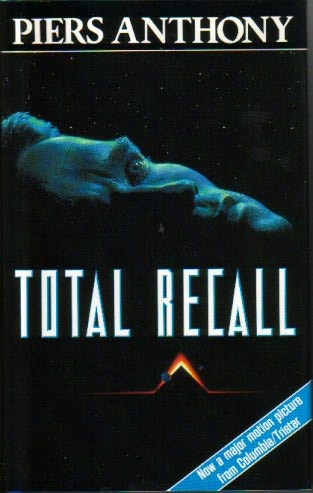
Too much time has been wasted arguing about which Philip K. Dick adaptation is greater: Blade Runner or Total Recall. The truth is, all the writers responsible for Total Recall were brilliant. Dick, of course, is a grandmaster of the genre, but “We Can Remember It For You Wholesale,” the film’s inspiration, was just a short story. Alien scriptwriters Ronald Shusett and Dan O’Bannon were among the writers who grew and adapted the story into a twisty-turny opus. There’s one more writer worth mentioning: The novelization of Total Recall by Piers Anthony, the acclaimed author of several best-selling fantasy and sci-fi series, was one of the few in film history worth reading.


The Tech

You have to love a film that has a box of technology, one of those briefcases given to the protagonist, who then pulls out each item one by one. Computer, hologram bracelet, self-guided nasal GPS implant remover. Every scene in the film has great technology–much of which are still cool ideas in the 21st century, from the instant color-changing nail to the self-driven taxi cabs. On the flip side, the extremely detailed body scans are already obsolete compared to the naked scans available now at airports. Howevever, the central piece of technology in the film is the memory-implant chair, part MRI, part hairstylist chair, which of course was ripped off for Joss Whedon’s contemporary mindfrak series, Dollhouse.


Mars

Missions to Mars and Red Planet—don’t try and tell us that these films scratch the itch fans feel for the fourth planet from the sun. Total Recall nails it: Not only is the planet colonized, but it’s a giant mining operation with its own train system, underground catacombs, red light district and taxi drivers who have to dodge giant drilling machines. While the colony is actually kinda cheesy (they really wouldn’t build it with bulletproof glass? Really? And why did The Last Resort seem classier than the Mars Hilton?), the fact remains that, like Quaid, we’d pick Mars over Saturn any day.

25 Years of “You’ve Got Fail”: 18 of AOL’s Biggest Mistakes

Written by Timothy James Duffy

This week AOL celebrates the company’s 25 year anniversary. Throughout the internet service provider turned online advertising company’s history, they’ve been the force behind some of the most epic web-related fails known to man.

While it would be impossible to document the company’s endless list of shortcomings, there are some that distinguish themselves from the pack.

Here are 18 of the AOL’s biggest fails throughout the years, in no particular order.

1. Customer Service Fail

In June of 2006, Vincent Ferrari called AOL in an attempt to cancel his account. After waiting 15 minutes to speak with a representative, Vincent soon found out that AOL wasn’t going to let him go so easily. Following much debate, AOL finally agreed to cancel his account, but made sure to let him know that they were only trying to keep him as a customer for his “own good.”

2. Digg Spam Fail

AOL was called out for the sketchy measures they took to make the front page of Digg.com in August of 2006. The company had pushed their Weblogs stories to the front page by encouraging employees to submit and Digg their own, and fellow staff members’ stories.

3. Rebranding Fail

AOL officially rebranded their company as “Aol.” in November of 2009. The new Aol. kicked off their launch with several new logos which were clearly created in five minutes using Photoshop. Just what AOL needed to revitalize their dying brand.

4. Bebo Fail

Following an $850 million acquisition in 2008, AOL announced this year that they would either be selling, or shutting down Bebo. Recently, current CEO Tim Armstrong went on record stating the deal “really fell apart.” I’d say so.

5. Search Data Fail

In August of 2006, AOL Research leaked a file containing 25 million keyword searches conducted by over 650,000 users on one of its websites. Though the data was intended for “research,” AOL users weren’t thrilled about the public release of potentially sensitive information. AOL pulled the file three days later.

6. Disk Solicitation Fail

Up until 2006, AOL was known for the massive distribution of their software installation disks. As the disks went largely unused, the company came under fire for their blatant disregard of the negative environmental impact that they had. In August of 2006, AOL decided to “go green” and halt the production of their disks.

7. Yahoo Cloning Fail

In April of 2007, AOL redesigned their site and encouraged visitors to “experience the new AOL.com.” Their new face, however, looked strangely familiar to some. Why? AOL’s new look was a complete rip-off of Yahoo.com. Apparently, AOL was reading Tony Robbins at the time — “If you want to be successful, find someone who has achieved the results you want and copy what they do and you’ll achieve the same results.” Unfortunately for AOL, it didn’t exactly play out like that.

8. Usenet Fail

In 1993, AOL gave their customers access to Usenet …limited access, that is. It soon came to light that AOL neglected to list one specific newsgroup in “standard view.” Which group, you ask? None other than alt.aol-sucks.The group, however, was listed in the “alternate view” with the altered description “flames and complaints about America Online” accompanying it.

9. Terms of Service Fail

In the early years of AOL’s popularity, the company came under fire for its strict and elaborate terms of service. Users of the service were required to agree to the terms listed, which gave them grounds to censor user-generated content – oh, and they did.

Here are just a few of AOL’s ridiculous terms of service violations:

  • Using words deemed “dirty” in AOL chatrooms (e.g. using the word “breast” when discussing how to prepare chicken in a cooking-themed chatroom).
  • Posting content with an “inappropriate” subject matter on AOL message boards (e.g. users discussing how to prevent hacking).
  • Creating a profile containing “bad” words (e.g. community leader Douglas Kuntz was unable to update his profile to display his last name as it violated AOL’s TOS).

10. 56k Connection Fail

The fact that some people are still forced to use 56k internet due to lack of broadband in their area is sad enough, AOL’s offering of the service is even sadder. For just $9.99 per month, you can enjoy the slowest internet connection in existence with AOL’s dated software included. What a deal!

11. AIM Pages Fail

Created with the intent of overthrowing the (then) popular social networking giant MySpace, AIM Pages debuted in May of 2006. Linking the social networking service with the widely used AOL Instant Messenger, the site was far from a success. AOL closed the doors on AIM Pages the following year, moving user profiles to Bebo.

12. Netscape.com Fail

In August of 2007, AOL revamped Netscape.com, turning it into a social bookmarking platform similar to Digg. As you probably know by now, the service wasn’t exactly a hit. AOL would eventually set up Netscape.com as a virtual clone of AOL.com.

13. Community Leaders Fail

Up until 2005, AOL monitored message boards and chatrooms using “community leaders.” These moderators were online volunteers who managed AOL’s communities without pay. A class action lawsuit was filed against AOL in 1999, claiming that their community leader program violated U.S. labor laws. The company immediately reduced the privileges and power of their community leaders, and eventually ended the program in 2005.

14. Overcharging Fail

Throughout their history, AOL has frequently come under fire for various billing issues. One of the most notable concerns was the fact that AOL rounded up 15 seconds of internet use to charge for a whole minute.  AOL was later sued for improper billing practices by former Ohio Attorney General Jim Petro.

15. Postmortem Billing Fail

If AOL is going to make it hard for you to cancel their services when you’re alive, they definitely aren’t going to make it any easier for you when you’re dead. In August of 2004, the official requirements for canceling the account of a deceased person were made public. Anyone wishing to cancel the account of a dead customer is required to send in a letter of cancellation with the following information included:

  • Master screen name of the account.
  • Name and billing address listed on the account.
  • Name of the account holder.
  • Method of payment used on the account.
  • The last four digits of the credit or debit card used to pay for the account.

16. AOL Broadband Fail

While they’ve been known for their 56k internet services, AOL also provided broadband …kinda. AOL partnered with cable and DSL providers across the country to package the AOL software with broadband internet (at a paid premium of course). Customers that had this package were charged up to $10 per month to use the feature heavy AOL software.

17. Goodmail Fail

AOL implemented Goodmail, a certified e-mail system, in 2005. This service allowed businesses to send e-mails to their customers with a stamp that identified them as a trusted source. This also reduced the risk of legit e-mails getting caught in spam filters. Not bad, right? Well, AOL decided to pass on the charges to customers, drawing criticism from AOL users nationwide.

18. Merger Fail

AOL and Time Warner combined forces to create AOL Time Warner in 2000. Time Warner soon found out that the merger was not mutually beneficial. Immediately following the merger, Time Warner saw a decrease in the profitability of AOL. In 2002, the company reported a 99 billion dollar loss, and elected to remove “AOL” from their name the following year. As 2009 came to a close, AOL ceased all relations with Time Warner, becoming a completely separate entity.

Got an AOL fail we’ve missed? Post it in our comments section.


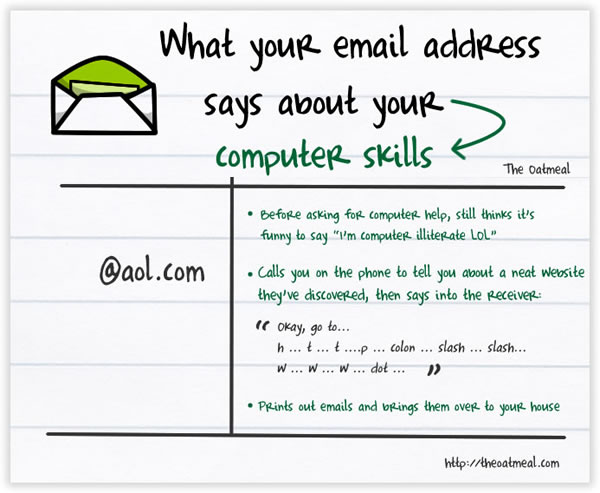
Bonus! What your aol email address says about you

source