Monthly Archives: September 2007

How to Turn Cheap ?Choice? Steaks into Gucci ?Prime? Steaks

Written by Steamy Kitchen


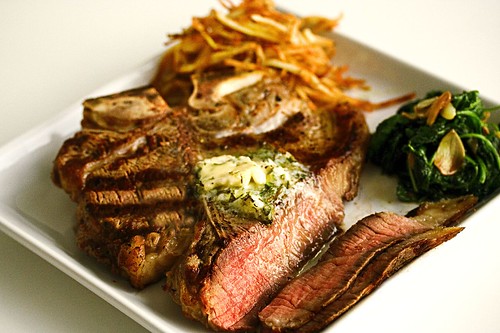
(Grilled Porterhouse with Garlic-Herb Butter, Shoestring Fries and Spinach with Garlic Chips. Thank you Kelly for cooking my spinach while I tended to my rugrat children who thought it would be funny to watch Mom trip over the marbles that they dumped down the stairs. Ha. Ha. That was funny boys.)

This recipe is published in my inaugural food column for Creative Loafing on Wednesday 8/29

If you are a meat-lover, I hope that the title of this post + luscious photo is enticing enough for you to read though the entire article. Because I promise you that it?s worth it. Even if you don?t eat meat, this is worth reading?as you can impress the hell outta your carnivorean friends. (and sometimes, when you?re a vegetarian in a herd of carnivores?it would just be nice to have that extra, “dude?.you didn?t know that about steak???!” in your pocket.)

My entire family (including the 2 yr old kid) just adores steak?you could probably classify us as professional carnivores. In fact, it is my husband?s life-long quest to hone his grilling technique so that our steaks at home turn out charred crusty on the outside and perfectly medium-rare on the inside. With grill marks for show, of course. Seriously, we are too cheap to eat out at nice steak restaurants. For the past 4 months, we have been experimenting with how to get full, juicy, beefy flavor of a ribeye with butter-knife tenderness of a filet mignon without paying up-the-butt for Prime cuts.

And by golly, after 4 months of eating steak 2x a week, I think we?ve figured it out.

So, my friends, I am offering you a very juicy secret, one that will turn an ordinary “Choice” cut of steak into a gucci “Prime” cut. Do you know the joy of buying Choice and eating Prime? It?s like buying a Hyundai and getting a free mail-in rebate for a BMW upgrade!!!

The secret after the jump?..

Massively salt your steaks 1 hour before grilling.

Notice that I didn?t say, “sprinkle liberally” or even “season generously.” I?m talking about taking a small handful of kosher salt and literally coating your meat until you can?t see red.

It should resemble a salt lick.

Let that meat be totally overwhelmed with the salt for 1 hour. Rinse, pat dry dry dry and then you?re ready to grill.

Before y?all throw a hissy fit, just hear me out. I first learned of this technique from Judy Rodgers? Zuni Caf? Cookbook. Judy massively salts her chicken before roasting, and I?ve adapted the practice to steaks. Thanks to a couple of other books (McGee?s On Food and Cooking and Alton Brown?s I?m Just Here For the Food), and a few fellow bloggers, I have somewhat of an explanation of how it works.

But just so you know?I slept through high school biology and chemistry, especially during the chapter on osmosis. I?m asking for any researchers, doctors, scientists, butchers, plumbers, professional chefs, mechanics?.basically anyone who didn?t sleep through school to add to this conversation. Mainly because maybe, there might be as many holes in my slideshow as there are in my pea-head.

Oh, and if the drawings look like a 3rd grader did it, too bad?.I?m not a artist, dammit!!! YOU try drawing with a laptop touch-pad and a glass of bourbon on the rocks.

Slide #1:

All of you who season JUST before grilling – this is what you are really doing to the meat. Did you know that? All the water comes to the surface and if you don?t pat super-dry, you?re basically STEAMING the meat.

But if you let it sit for a while?this is what happens: cue Slide #2:

Slide #3:

Bourbon does that to me too.

Ok, Slide #4: After you let it rest, then

I can hear it now..”BUT?.BUT?BUT?.what of all the water that stayed on the surface of the meat? Not all the water gets reabsorbed! (*%!*%!@#!#!!! I DON?T UNDERSTAND!!!”

Sit back down?and let?s move on to Slide #5:

I meant “prune” not “prude” – but whatever. too lazy to modify the jpg.

Why not brine?
Well, yeah?you could. But that involves measuring, finding a big enough container, dissolving, finding enough space in the refrigerator for the big container, chilling, waiting, waiting, waiting, draining, washing big fat container, unchilling the meat to bring to room temp. Waaaayyyy too much work for a simple gal. Plus, brined steak tastes like shit. Because of high water concentration of a brine, you are ADDING a lot of water into the meat. Not what you want for a steak.

Other Notes

  • Use kosher salt, not iodized table salt?or else your meat will taste like?well?iodine. EDIT: Sea Salt works just as well too!!
  • Use 1-2 teaspoons of kosher salt per side. Just salt until you can?t see red. See the photo above. That huge Porterhouse took about 2 tsps of kosher salt. Some of the salt already dissolved by the time I got out my camera?.it was really, really covered in salt. For smaller cuts – use 1 tsp.
  • I generally salt between 1-3 hours (the last hour on the counter top at room temperature) depending on the thickness of the steak (an hour-ish for every inch). Personally, my favorite is a steak 1-1/2″ thick that I let salt for 1.5 hour-ish on the counter.
  • Don?t worry about exact measurements or timing. (did you notice the abundance of “-ish”???) You don?t even need a measuring spoon – just take a small handful of salt. Just make sure that you let it sit at least an hour-ish. This method is extremely flexible-ish and works damn well every single time. I promise you won?t be disappointed-ish.
  • I haven?t tried salting Filet Mignon by itself (without the Porterhouse bone). Someone want to try and report back? My opinion, the best cuts to use are Rib Eye, Porterhouse, T-Bone and NY Strip.
  • If you are Howard McGee, a member of Alton Brown?s research team or Mr. Burke my high school bio teacher?..and think I?m full of B.S?. please let me know. But guys, none of this was in your books. I had to formulate, extrapolate, hypotholate and guesstulate based on your stuff. Highly mental activity.
  • If you are not one of the above but have a better explanation than I my little brain could muster, please let me know.
  • With respect, Ms.Judy Rogers, I?d like to suggest that your explanation of why salting works in your book may be incorrect. Reverse osmosis doesn?t happen by itself?it requires an abundance of external force?kinda like me trying to get my kids to pick up their toys.
  • Should I call this Salt-Curing, Dry-Brining, Salting, Dry Rubbing or just plain Idiotic? This sounds awfully like salt-curing – but doesn?t that dry out meat (like beef jerky)? Well yes it does – but when you use A LOT more salt and leave it salting for A LOOOOOONG time. We?re talking about an hour-ish nap here – not weeks – just enough to break down the protiens.

I understand that this method will cause chaos, confusion and controversy in your household. But I encourage you to experiment ? try adding spices, crushed garlic and rosemary sprigs to the salt, which will then act like Christina Aguilera dragging its entourage of flavors with it into the meat.

If confusion in the household becomes unbearable, just whack?em with the hunk of salty meat.

Grilled Steak with Garlic-Herb Butter

Step 1: Buy a hunk of steak 1-inch thick or more. I like mine 1?-inches thick. Rib Eye, Porterhouse, T-Bone and NY Strip work perfectly. Edit- just tried Filet Mignon tonight?.deeeeluscious! Another reader had great success with Elk.

Step 2: About 1-2 teaspoons of kosher salt per side. Small girly 1lb steak = 1 tsp. Manly man 2lb steak = 2 tsp. Let it sit on counter for 1 hr for every inch in thickness. Not all of the moisture will be re-absorbed back in. In fact, you will see quite a bit of water. That?s ok. Don?t panic. Read slides above for explanation.

Step 3: Rinse all salt off, pat very dry <- that part is important. Season with fresh ground pepper (no more salt is needed). Grill to your liking. Hint: get yourself a grilling thermometer. Top with Garlic-Herb Butter immediately to let it oooooze and aaaahhze all over the steak.

Garlic-Herb Butter

1 stick of unsalted butter, softened
handful of fresh herbs (any combination is fine. My fav is basil and parsley)
1-3 cloves of garlic, smushed in garlic press

To make the Garlic-Herb Butter, combine all ingredients. Lay out a sheet of plastic wrap. Spoon butter mixture on wrap. Roll and shape butter into a log. Refrigerate to firm up for 30 minutes. Slice into 1/4? disks to top the grilled steaks. You can make butter up to 3 days in advance.

Notice the consistency in ingredients (first photo and the one below): perfect steak always go so well with homemade shoestring fries or homemade potato chips. The green stuff is just to give color to the plate.

unless it has garlic-herb butter slathered all over it too.

40 Unusual Websites you should Bookmark

Written by Aibek

If you’re long time makeuseof reader at one point or another you may have seen several of these websites before. We have covered lots of lists and round-ups but this one is quite different: it lists undiscovered webservices that are original, rather unique, unusual, useful, free, and must-be bookmarked type. You won’t find any collaboration, storage or ToDo service here. Enjoy!

Unique Websites

1. BugMeNot – instantly get disposable login details for any popular website that force you to register.

2. DailyLit – read your favorite books by email (on your PC, mobile, etc.).

3. FranceRadio – neat MP3 Search Engine that lets you Find, Play and Download favorite MP3s for FREE.

4. Google SMS – provides mobile users with a quick access (via SMS) to a wide range of practical information and tools (i.e. business listings (pizzerias, shops, etc.), weather, movie listings, driving directions, currency converter and lots more.

5. Podlinez – listen to your favorite podcasts from any phone. Just enter the RSS feed URL for the desired podcast and get a free-toll number to access it from phone.

6. RetailMeNot – locate fresh discount coupons for thousands of web merchants and services right from your browser toolbar. Video demo.

7. SoLow – on a daily basis SoLow auctions 4 different items (iPhones, HD Screens, etc.). Anyone with a mobile/PC can participate in the auctions by placing their bids via text-messaging. The user with the lowest unique bid wins the auction.

8. TeleFlip – auto-forward your emails to your cellphone as text messages. Video demo.

9. UrbanDictionary – hilarious (and practical) 100% user-maintained dictionary where users provide and vote on definitions for urban words (slangs).

10. Yak4Ever – make free international calls from US, UK and Ireland to 50+ countries.

=== Mobile – related ===

11. Bitbom – schedule free text message reminders to your phone. Schedule online or using mobile. (Similar PingMe.)

12. Flurry – follow up on your emails (send, receive) and receive latest articles from favorite blogs/websites on your mobile.

13. Foonz – place group calls and send messages to multiple people for free (from your mobile or any other phone).

14. GameJump – lots of free games for mobile phones.

15. GrandCentral – single phone number for all your phones and a web-based centralized voicemail system. (Similar: YouMail, GotVoice)

16. IQzone – post your classified ad to a number of online and print classifieds networks directly from your mobile.

17. Jott – simple and convenient service for leaving yourself notes and ToDo remainders using your mobile.

18. Mosio – text any question from your mobile phone and shortly receive up-to 4 answers.

19. mShopper – instantly check up on the bargain deals for any product (or even order) right from your mobile phone. Video demo.

20. NoPhoneTrees – simple phone directory that lists direct human access numbers to support employees in hundreds of companies.

21. Nutsie – takes a copy of your iTunes library file and creates an online copy of your library. Access this library from PC or mobile phone.

22. Google SendToPhone – forward anything you find on the web (maps, address, text, etc.) to any mobile phone for free (US only).

23. Qipit – take a quick document pictures and turn them into properly formatted PDFs. Save online, email, or fax documents right from mobile.

24. Soonr – handy application that lets you access your PC remotely using your mobile or any other PC (work, school, etc.). Video demo.

25. TelePixie – quickly schedule and receive daily (or one time) wake up phone calls, reminders, weather forecast calls, jokes, and more.

26. TellMe – free local directory service for business listings (Car Repair Shops, Pizzerias, Restaurants, etc.), maps, and directions.

27. PhoneZoo – convert your MP3s to custom-length ringtones and forward them to your phone. Plus 1000s of free ringtones from other users.

=== Other ===

28. BossBitching – fun and active community where people can bit*h about their bosses anonymously.

29. eSnailer – send free postal mail letters (to anywhere in the US) right from the desktop. From Canada? Check out EasyPost.

30. Yapta – get a refund (or credit) from the airlines on a purchased ticket in case its price drops.

31. ListenToaMovie – lets you ‘listen to a movie’, i.e. stream the audio part of various movies and a some TV-shows.

32. OpenDNS – provides a safer, faster, smarter and more reliable way to navigate the Internet. More details + video demo.

33. PodioBooks – search, subscribe and browse through a variety of totally free audio books (100% legal).

34. PriceProtectr – tracks items you bought online drops and notifies in case of price-drops so you can request a refund.

35. RateMyDrawings – excellent place to draw, share your drawing creations, learn to draw, and watch other people drawing. Video demo

36. SwitchPlanet – cool and active marketplace where you can switch (or trade) used DVDs, CDs, Video Games and Books. Video demos.

37. Scribd– search, browse, rate, share various types of documents (jokes, facts, stories etc.). It’s like Youtube for text documents.

38. ViaTalk – make up-to 10 minutes long free phone calls to anywhere in the US and Canada. You don’t even need to sign-up.

39. VideoSiftpopular Digg-like voting community for user-submitted videos.

40. Wordie – make lists of words (words you love, words you hate, or whatever) and share them with others.

10 Future Web Trends

Written by Richard MacManus

We’re well into the current era of the Web, commonly referred to as Web 2.0. Features of this phase of the Web include search, social networks, online media (music, video, etc), content aggregation and syndication (RSS), mashups (APIs), and much more. Currently the Web is still mostly accessed via a PC, but we’re starting to see more Web excitement from mobile devices (e.g. iPhone) and television sets (e.g. XBox Live 360).

What then can we expect from the next 10 or so years on the Web? As NatC commented in this week’s poll, the biggest impact of the Web in 10 years time won’t necessarily be via a computer screen – “your online activity will be mixed with your presence, travels, objects you buy or act with.” Also a lot of crossover will occur among the 10 trends below (and more) and there will be Web technologies that become enormously popular that we can’t predict now.

Bearing all that in mind, here are 10 Web trends to look out for over the next 10 years…

1. Semantic Web

Sir Tim Berners-Lee’s vision for a Semantic Web has been The Next Big Thing for a long time now. Indeed it’s become almost mythical, like Moby Dick. In a nutshell, the Semantic Web is about machines talking to machines. It’s about making the Web more ‘intelligent’, or as Berners-Lee himself described it: computers “analyzing all the data on the Web – the content, links, and transactions between people and computers.” At other times, Berners-Lee has described it as “the application of weblike design to data” – for example designing for re-use of information.

As Alex Iskold wrote in The Road to the Semantic Web, the core idea of the Semantic Web is to create the meta data describing data, which will enable computers to process the meaning of things. Once computers are equipped with semantics, they will be capable of solving complex semantical optimization problems.

So when will the Semantic Web arrive? The building blocks are here already: RDF, OWL, microformats are a few of them. But as Alex noted in his post, it will take some time to annotate the world’s information and then to capture personal information in the right way. Some companies, such as Hakia and Powerset and Alex’s own AdaptiveBlue, are actively trying to implement the Semantic Web. So we are getting close, but we are probably a few years off still before the big promise of the Semantic Web is fulfilled.

Semantic Web pic by dullhunk

2. Artificial Intelligence

Possibly the ultimate Next Big Thing in the history of computing, AI has been the dream of computer scientists since 1950 – when Alan Turing introduced the Turing test to test a machine’s capability to participate in human-like conversation. In the context of the Web, AI means making intelligent machines. In that sense, it has some things in common with the Semantic Web vision.

We’ve only begun to scratch the surface of AI on the Web. Amazon.com has attempted to introduce aspects of AI with Mechanical Turk, their task management service. It enables computer programs to co-ordinate the use of human intelligence to perform tasks which computers are unable to do. Since its launch on 2 November 2005, Mechanical Turk has gradually built up a following – there is a forum for “Turkers” called Turker Nation, which appears to have light-to-medium level patronage. However we reported in January that Mturk isn’t being used as much as the initial hype period in Nov-Dec 05.

Nevertheless, AI has a lot of promise on the Web. AI techniques are being used in “search 2.0” companies like Hakia and Powerset. Numenta is an exciting new company by tech legend Jeff Hawkins, which is attempting to build a new, brain-like computing paradigm – with neural networks and cellular automata. In english this means that Numenta is trying to enable computers to tackle problems that come easy to us humans, like recognizing faces or seeing patterns in music. But since computers are much faster than humans when it comes to computation, we hope that new frontiers will be broken – enabling us to solve the problems that were unreachable before.

3. Virtual Worlds

Second Life gets a lot of mainstream media attention as a future Web system. But at a recent Supernova panel that Sean Ammirati attended, the discussion touched on many other virtual world opportunities. The following graphic summarizes it well:

Looking at Korea as an example, as the ‘young generation’ grows up and infrastructure is built out, virtual worlds will become a vibrant market all over the world over the next 10 years.

It’s not just about digital life, but also making our real life more digital. As Alex Iskold explained, on one hand we have the rapid rise of Second Life and other virtual worlds. On the other we are beginning to annotate our planet with digital information, via technologies like Google Earth.

4. Mobile

Mobile Web is another Next Big Thing on slow boil. It’s already big in parts of Asia and Europe, and it received a kick in the US market this year with the release of Apple’s iPhone. This is just the beginning. In 10 years time there will be many more location-aware services available via mobile devices; such as getting personalized shopping offers as you walk through your local mall, or getting map directions while driving your car, or hooking up with your friends on a Friday night. Look for the big Internet companies like Yahoo and Google to become key mobile portals, alongside the mobile operators.

Companies like Nokia, Sony-Ericsson, Palm, Blackberry and Microsoft have been active in the Mobile Web for years now, but one of the main issues with Mobile Web has always been usability. The iPhone has a revolutionary UI that makes it easier for users to browse the Web, using zooming, pinching and other methods. Also, as Alex Iskold noted, the iPhone is a strategy that may expand Apple’s sphere of influence, from web browsing to social networking and even possibly search.

So even despite the iPhone hype, in the US at least (and probably other countries when it arrives) the iPhone will probably be seen in 10 years time as the breakthrough Mobile Web device.

5. Attention Economy

The Attention Economy is a marketplace where consumers agree to receive services in exchange for their attention. Examples include personalized news, personalized search, alerts and recommendations to buy. The Attention Economy is about the consumer having choice – they get to choose where their attention is ‘spent’. Another key ingredient in the attention game is relevancy. As long as the consumer sees relevant content, he/she is going to stick around – and that creates more opportunities to sell.

Expect to see this concept become more important to the Web’s economy over the next decade. We’re already seeing it with the likes of Amazon and Netflix, but there is a lot more opportunity yet to explore from startups.


Image from The Attention Economy: An Overview, by Alex Iskold

6. Web Sites as Web Services

Alex Iskold wrote in March that as more and more of the Web is becoming remixable, the entire system is turning into both a platform and the database. Major web sites are going to be transformed into web services – and will effectively expose their information to the world. Such transformations are never smooth – e.g. scalability is a big issue and legal aspects are never simple. But, said Alex, it is not a question of if web sites become web services, but when and how.

The transformation will happen in one of two ways. Some web sites will follow the example of Amazon, del.icio.us and Flickr and will offer their information via a REST API. Others will try to keep their information proprietary, but it will be opened via mashups created using services like Dapper, Teqlo and Yahoo! Pipes. The net effect will be that unstructured information will give way to structured information – paving the road to more intelligent computing.

Note that we can also see this trend play out currently with widgets and especially Facebook in 2007. Perhaps in 10 years time the web services landscape will be much more open, because the ‘walled garden’ problem is still with us in 2007.


Image from Web 3.0: When Web Sites Become Web Services, by Alex Iskold

7. Online Video / Internet TV

This is a trend that has already exploded on the Web – but you still get the sense there’s a lot more to come yet. In October 2006 Google acquired the hottest online video property on the planet, YouTube. Later on that same month, news came out that the founders of Kazaa and Skype were building an Internet TV service, nicknamed The Venice Project (later named Joost). In 2007, YouTube continues to dominate. Meanwhile Internet TV services are slowly getting off the ground.

Our network blog last100 has an excellent overview of the current Internet TV landscape, with reviews of 8 Internet TV apps. Read/WriteWeb’s Josh Catone also reviewed 3 of them – Joost, Babelgum, Zattoo.

It’s fair to say that in 10 years time, Internet TV will be totally different to what it is today. Higher quality pictures, more powerful streaming, personalization, sharing, and much more – it’s all coming over the next decade. Perhaps the big question is: how will the current mainstream TV networks (NBC, CNN, etc) adapt?


Zattoo, from Internet Killed The Television Star: Reviews of Joost, Babelgum, Zattoo, and More, by Josh Catone

8. Rich Internet Apps

As the current trend of hybrid web/desktop apps continues, expect to see RIA (rich internet apps) continue to increase in use and functionality. Adobe’s AIR platform (Adobe Integrated Runtime) is one of the leaders, along with Microsoft with its Windows Presentation Foundation. Also in the mix is Laszlo with its open source OpenLaszlo platform and there are several other startups offering RIA platforms. Let’s not forget also that Ajax is generally considered to be an RIA – it remains to be seen though how long Ajax lasts, or whether there will be a ‘2.0’.

As Ryan Stewart wrote for Read/WriteWeb back in April 2006 (well before he joined Adobe), “Rich Internet Apps allow sophisticated effects and transitions that are important in keeping the user engaged. This means developers will be able to take the amazing changes in the Web for granted and start focusing on a flawless experience for the users. It is going to be an exciting time for anyone involved in building the new Web, because the interfaces are finally catching up with the content.”

The past year has proven Ryan right, with Adobe and Microsoft duking it out with RIA technologies. And there’s a lot more innovation to happen yet, so in 10 years time I can’t wait to see what the lay of the RIA land is!

9. International Web

As of 2007, the US is still the major market in the Web. But in 10 years time, things might be very different. China is often touted as a growth market, but other countries with big populations will also grow – India and African nations for example.

For most web 2.0 apps and websites (R/WW included), the US market makes up over 50% of their users. Indeed, comScore reported in November 2006 that 3/4 of traffic to top websites is international. comScore said that 14 of the top 25 US Web properties now attract more visitors from outside the US than from within. That includes the top 5 US properties – Yahoo! Sites, Time Warner Network, Microsoft, Google Sites, and eBay.

However, it is still early days and the revenues are not big in international markets at this point. In 10 years time, revenue will probably be flowing from the International Web.

10. Personalization

Personalization has been a strong theme in 2007, particularly with Google. Indeed Read/WriteWeb did a feature week on Personalizing Google. But you can see this trend play out among a lot of web 2.0 startups and companies – from last.fm to MyStrands to Yahoo homepage and more.

What can we expect over the next decade? Recently we asked Sep Kamvar, Lead Software Engineer for Personalization at Google, whether there will be a ‘Personal PageRank’ system in the future. He replied:

“We have various levels of personalization. For those who are signed up for Web History, we have the deepest personalization, but even for those who are not signed up for Web History, we personalize your results based on what country you are searching from. As we move forward, personalization will continue to be a gradient; the more you share with Google, the more tailored your results will be.”

If nothing else, it’ll be fascinating to track how Google uses personalization over the coming years – and how it deals with the privacy issues.

Conclusion

We’ve covered a lot of ground in this post, so tell us know what you think of our predictions. What other Web trends do you forsee over the next decade?

We offer guaranteed online preparation for ccna security, the most popular ccna voice and ccna wireless exam.

10 Ways Your Resume Irks Hiring Managers

Written By MARY LORENZ, CAREERBUILDER.COM WRITER

Fashion designer Coco Chanel had a personal rule: Before she left the house, the style icon always removed one piece of her ensemble to avoid the faux-pas of wearing too many accessories. Were Chanel alive today and working as a hiring manager, she would likely offer similar advice to job seekers: You don’t have to include everything.

Job seekers do themselves a disservice when they send out resumes with more information than they need. Most employers don’t have the time or patience to sift through the irrelevant details. Here are 10 things your resume could do without:

1. Spelling mistakes and grammatical errors. “If you are careless enough to send out this most important document with a mistake … I immediately assume you’ll never care enough about the work you send out representing my company,” says Jose Bandujo, president of New York-based Bandujo Advertising. He recalls one candidate who misspelled Manhattan, despite having worked in the city for a decade and another whose great educational background didn’t compensate for the fact that he couldn’t spell “education.”

2. Opening objectives. “These are generic … They do nothing to differentiate one candidate from another,” says Donna Flagg, president of The Krysalis Group, a human resource and management consulting firm in New York.

3. Personal attributes. Listing personal information such as height, weight and age and providing photographs is a pet peeve for Heather Mayfield, vice president of training and operations for Snelling Staffing Services. “It is amazing that we still see this on the resumes of today, but they are out there.”

4. Interests and hobbies. If these points of information don’t pertain to the job in question, there’s no need to include them. “Create a mystery and save these kinds of data points when you start the job,” advises Roy Blitzer, author of ‘Hire Me, Inc.: Resumes and Cover Letters that Get Results.’

5. Details of every task you’ve ever performed in every job you’ve ever had. “It’s too much information. Managers and recruiters need to know at-a-glance what makes a candidate special,” Flagg says. Focus on those details that pertain to the job for which you’re applying.

6. Excessive bragging. Stating one’s accomplishments can be helpful, but when it’s overdone, the candidate can come across as narcissistic, a huge turnoff for employers, Flagg says.

7. Outdated information. Leave off the activities that you did in high school if graduation was a few years ago and omit jobs you held 10 or more years ago, as the information is probably irrelevant to the position you’re trying for now.

8. False information. “Putting that you have a B.S. on a resume when you do not have one is BS,'” jokes Stephen Viscusi, author of ‘On the Job: How to Make it in the Real World of Work.” Not only is lying on a resume unfair and dishonest, it’s also not very intelligent. “Companies verify dates of employment — often after you start. If you have lied, they fire you…Nobody wants to hire a liar. Nobody.”

9. Unexplained gaps in work history. While job seekers should account for these gaps, they should be careful with their wording. “One of the weirdest things that I ever saw on a resume … was a candidate who explained a 10-year lapse in work experience as being in jail during those years for killing her husband,” recalls Linda Goodspeed, marketing recruiting manager at VistaPrint. In such a situation, she says, the best thing to write would be “left work for personal reasons,” and the candidate would be able to explain the criminal record later.

10. A lack of professionalism. Colored paper, cutesy fonts, links to personal web sites and childish e-mail addresses all scream unprofessional and are a turn off to hiring managers. One otherwise qualified applicant didn’t get an interview at Bandujo’s firm solely because of the name in her email address: “weird2themax.” “I recognize the advertising industry is full of talented, interesting ‘characters’,” Bandujo says, “but did I really want one who thought she was weird to the max?” No, he decided, he did not.

Copyright 2007 CareerBuilder.com.

Do You Remember Your First Experience with the Internet?

Written by ob81

Do you remember the first time you used the internet? I do.

I was thinking about it the other day, reminiscing about when it all started. It actually is pretty weird in a way. I had a computer at home, but it was used as an educational tool for my brothers and me. We had tons of math and word games that we would play all day. No internet of course.

It wasn’t until the summer of my freshman year in High School that I finally logged on to the internet. It’s odd that I remember it so vividly. It was June 1996, and I had a job as a Caddy at a Golf Club in Highland Park, IL. That summer, my place of residence was at Northwestern University in the suburbs of Chicago. I was staying in a College Co-Ed dorm as a freshman in High School!

It was fun to say the least, but that’s another story in its own. How this ties in is, my best friend that summer was a girl named Katie. Katie was a sophomore at Northwestern and took classes during the summer so she could graduate early. She was smart, but one of the nastiest people I have ever met in my life.

The only image that comes up when I remember her is her holding a beer and most of the front of her shirt being wet from spilling beer on herself. She was one of those people that couldn’t eat or drink without spilling something on her. It was weird as I am a very neat person, but I can be friends with anyone.

Katie would study all day. Drink and Party all night, and then hang out at a small computer room on campus and actually slept in there sometimes. I was always curious about the computer room, but I got up early in the mornings, and was normally tired from being on a Golf Course all day.

One weekend Katie said I should try the internet out, but it was best to go late at night as there were only 3 computers in the room, and during the day people were always on them.

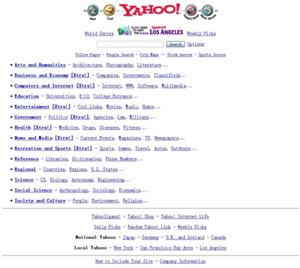
I can’t tell you what type of computer it was, but the browser was Netscape and the Home Page was Yahoo! I didn’t know what the heck a Yahoo! was, but it had a list of everything that it could connect me to it seemed. The site looked nothing like Yahoo! looks today. It was a search box, some Yahoo! Icons, and a list in category fashion, like sports, cars, dating, and other stuff like that.

Turns out that Katie was always chatting on those late nights in the computer room, and I was a recruit to be her arguing buddy. I wonder if that chat site still exists. I can’t check it now as I am writing this from work. I would search for “Lil’ Chat Hotel” in Yahoo!, and I would know which one to click. The whole URL thing was foreign to me.

Katie and I started going to the computer room EVERY night, for hours chatting on this site. I couldn’t believe how fun it was, and somehow comforting. I guess that was my first experience with social networking in a way also. It also is what started my addiction to the internet.

Damn you Katie!!

Do you remember your first experience?

25 of The World?s Most Interesting Animals

Written by Chief

Leafy seadragon

Leafy Seadragon

Named after the dragons of Chinese mythology, Leafy seadragons (Phycodurus eques) resemble a piece of drifting seaweed as they float in the seaweed-filled water. The Leafy seadragon, with green, orange and gold hues along its body, is covered with leaf-like appendages, making it remarkably camouflaged. Only the fluttering of tiny fins or the moving of an independently swiveling eye, reveals its presence.

Like the seahorse, the male seadragon carries as many as 150-200 eggs. After being deposited by the female, the eggs are carried in the honeycomb-shaped area (known as the brood patch) under the male’s tail for approximately eight weeks. Seadragons have no teeth or stomach and feed exclusively on mysidopsis shrimp. Known as “Australian seahorses” in Australia, they are found in calm, cold water that is approximately 50-54? F (10-12? C). Leafy seadragons have been protected by the South Australian government since 1982.

Sun Bear

Sun Bear

The Sun Bear (Helarctos malayanus) is a bear found primarily in the tropical rainforests of Southeast Asia.

The Sun Bear stands approximately 4 ft (1.2 m) in length, making it the smallest member in the bear family. It is often called the dog bear because of its small stature. It has a 2 in (5 cm) tail and on average weighs less than 145 lb (65 kg). Males tend to be slightly larger than females.

Unlike other bears, the Sun Bear’s fur is short and sleek. This adaptation is probably due to the lowland climates it inhabits. Dark black or brown-black fur covers its body, except on the chest where there is a pale orange-yellow marking in the shape of a horseshoe. Similar colored fur can be found around the muzzle and the eyes. This distinct marking gives the sun bear its name.

Komondor Dog

Komondor Dog

Females are 27 inches (69cm) at the withers. Male Komondorok are a minimum of 28 inches at the withers, but many are over 30 inches tall, making this one of the larger common breeds of dog. The body is not overly coarse or heavy, however, and people unfamiliar with the breed are often surprised by how quick and agile the dogs are.

Its long, thick, strikingly corded white coat (the heaviest amount of fur in the canine world) resembles dreadlocks or a mop. The puppy coat is soft and fluffy. However, the coat is wavy and tends to curl as the puppy matures. A fully mature coat is formed naturally from the soft undercoat and the coarser outer coat combining to form tassels, or cords. Some help is needed in separating the cords so the dog does not turn into one large matted mess. The length of the cords increases with time as the coat grows. Shedding is very minimal with this breed, contrary to what one might think (once cords are fully formed). The only substantial shedding occurs as a puppy before the dreadlocks fully form. The Komondor is born with only a white coat, unlike the similar-looking Puli, which is usually white, black or sometimes grayish. However, a working Komondor’s coat may be discolored by the elements, and may appear off-white if not washed regularly.

Angora Rabbit

Angora Rabbit

The Angora rabbit is a variety of domestic rabbit bred for its long, soft hair. The Angora is one of the oldest types of domestic rabbit, originating in Ankara, Turkey, along with the Angora cat and Angora goat. The rabbits were popular pets with French royalty in the mid 1700s, and spread to other parts of Europe by the end of the century. They first appeared in the United States in the early 1900s. They are bred largely for their long wool, which may be removed by shearing or plucking (gently pulling loose wool).

There are many individual breeds of Angora rabbits, four of which are ARBA recognized. Such breeds include, French, German, Giant, English, Satin, Chinese, Swiss, Finnish, to name a few.

Red Panda

Red Panda

The Red Panda, Ailurus fulgens (“shining cat,” from a Latinized form of the Greek, ailouros, “cat,” and the participial form of the Latin fulgere, “to shine”) is a mostly herbivorous mammal, slightly larger than a domestic cat (55 cm long). The Red Panda has semi-retractile claws and, like the Giant Panda, has a “false thumb” which is really an extension of the wrist bone. Thick fur on the soles of the feet offers protection from cold and hides scent glands. The Red Panda is native to the Himalayas in Nepal and southern China. The word panda is derived from Nepalese word “ponya” which means bamboo and plants eating animals in Nepal.

Sloth

Sloth

Sloths are medium-sized mammals that live in Central and South America belonging to the families Megalonychidae and Bradypodidae, part of the order Pilosa. Most scientists call these two families the Folivora suborder, while some call it Phyllophaga.

Sloths are omnivores. They may eat insects, small lizards and carrion, but their diet consists mostly of buds, tender shoots, and leaves.

Sloths have made extraordinary adaptations to an arboreal browsing lifestyle. Leaves, their main food source, provide very little energy or nutrition and do not digest easily: sloths have very large, specialized, slow-acting stomachs with multiple compartments in which symbiotic bacteria break down the tough leaves.

As much as two-thirds of a well-fed sloth’s body-weight consists of the contents of its stomach, and the digestive process can take as long as a month or more to complete. Even so, leaves provide little energy, and sloths deal with this by a range of economy measures: they have very low metabolic rates (less than half of that expected for a creature of their size), and maintain low body temperatures when active (30 to 34 degrees Celsius or 86 to 93 degrees Fahrenheit), and still lower temperatures when resting. Sloths mainly live in Cecropia trees.

Emperor Tamarin

Emperor Tamarin

The Emperor Tamarin (Saguinus imperator) is a tamarin allegedly named for its similarity with the German emperor Wilhelm II. The name was first intended as a joke, but has become the official scientific name.
This tamarin lives in the southwest Amazon Basin, in east Peru, north Bolivia and in the west Brazilian states of Acre and Amazonas.
The fur of the Emperor Tamarin is predominantly grey colored, with yellowish speckles on its chest. The hands and feet are black and the tail is brown. Outstanding is its long, white mustache, which extends to both sides beyond the shoulders. The animal reaches a length of 24 to 26 cm, plus a 35 cm long tail. It weighs approximately 300 to 400 g.
This primate inhabits tropical rain forests, living deep in the forest and also in open tree-covered areas. It is a diurnal animal, spending the majority of its days in the trees with quick, safe movements and broad jumps among the limbs.

White-faced Saki Monkey

White Faced Saki Monkey

The White-faced Saki (Pithecia pithecia), also known as the Guianan Saki and the Golden-faced Saki, is a species of saki monkey, a type of New World monkey, found in Brazil, French Guiana, Guyana, Suriname, and Venezuela. This monkey mostly feed on fruits, but also nuts, seeds, and insects.

Tapir

Tapir

Tapirs are large browsing mammals, roughly pig-like in shape, with short, prehensile snouts. They inhabit jungle and forest regions of South America, Central America, and Southeast Asia. All four species of tapir are classified as endangered or vulnerable. Their closest relatives are the other odd-toed ungulates, horses and rhinoceroses.

Hagfish

Hagfish

Hagfish are marine craniates of the class Myxini, also known as Hyperotreti. Despite their name, there is some debate about whether they are strictly fish (as there is for lampreys), since they belong to a much more primitive lineage than any other group that is commonly defined fish (Chondrichthyes and Osteichthyes). Their unusual feeding habits and slime-producing capabilities have led members of the scientific and popular media to dub the hagfish as the most “disgusting” of all sea creatures.

Hagfish are long, vermiform and can exude copious quantities of a sticky slime or mucus (from which the typical species Myxine glutinosa was named). When captured and held by the tail, they escape by secreting the fibrous slime, which turns into a thick and sticky gel when combined with water, and then cleaning off by tying themselves in an overhand knot which works its way from the head to the tail of the animal, scraping off the slime as it goes. Some authorities conjecture that this singular behavior may assist them in extricating themselves from the jaws of predatory fish. However, the “sliming” also seems to act as a distraction to predators, and free-swimming hagfish are seen to “slime” when agitated and will later clear the mucus off by way of the same travelling-knot behavior.

Star-nosed Mole

Star Nosed Mole

The Star-nosed Mole (Condylura cristata) is a small North American mole found in eastern Canada and the north-eastern United States. It is the only member of the tribe Condylurini and the genus Condylura.

It lives in wet lowland areas and eats small invertebrates, aquatic insects, worms and molluscs. It is a good swimmer and can forage along the bottoms of streams and ponds. Like other moles, this animal digs shallow surface tunnels for foraging; often, these tunnels exit underwater. It is active day and night and remains active in winter, when it has been observed tunnelling through the snow and swimming in ice-covered streams. Little is known about the social behavior of the species, but it is suspected that it is colonial.

The Star-nosed Mole is covered in thick blackish brown water-repellent fur and has large scaled feet and a long thick tail, which appears to function as a fat storage reserve for the spring breeding season. Adults are 15 to 20 cm in length, weigh about 55 g, and have 44 teeth. The mole’s most distinctive feature is a circle of 22 mobile, pink, fleshy tentacles at the end of the snout. These are used to identify food by touch, such as worms, insects and crustaceans.

Proboscis Monkey

Proboscis Monkey

Nasalis larvatus also known as Long-nosed Monkey is a reddish-brown arboreal Old World monkey. It is the only species in monotypic genus Nasalis.

The most distinctive trait of this monkey is the male’s large protruding nose. The purpose of the large nose is unclear, but it has been suggested that it is a result of sexual selection. The female Proboscis Monkey prefers big-nosed male, thus propagating the trait.

Males are much larger than females, reaching 72 cm (28 inches) in length, with an up to 75 cm tail, and weighing up to 24 kg (53 pounds). Females are up to 60 cm long, weighing up to 12 kg (26 lb).

The Proboscis Monkey also has a large belly, as a result of its diet. Its digestive system is divided into several parts, with distinctive gut flora, which help in digesting leaves. This digestive process releases a lot of gas, resulting in the monkey’s “bloated” bellies. A side-effect of this unique digestive system is that it is unable to digest ripe fruit, unlike most other simians. The diet consists mainly of fruits, seeds and leaves.

Pink Fairy Armadillo

Pink Fairy Armadillo

The Pink Fairy Armadillo (Chlamyphorus truncatus) or Pichiciego is the smallest species of armadillo (mammals of the family Dasypodidae, mostly known for having a bony armor shell). It is approximately 90-115 mm (3?-4?”) long excluding the tail, and is pale rose or pink in color. It is found in central Argentina where it inhabits dry grasslands and sandy plains with thorn bushes and cacti. It has the ability to bury itself completely in a matter of seconds if frightened.

The Pink Fairy Armadillo burrows small holes near ant colonies in dry dirt. It feeds mainly on ants and ant larvae near its burrow. Occasionally it feeds on worms, snails, insects and larvae, or various plant and root material.

Axolotl

Axolotl

The Axolotl (or ajolote) (Ambystoma mexicanum) is the best-known of the Mexican neotenic mole salamanders belonging to the Tiger Salamander complex. Larvae of this species fail to undergo metamorphosis, so the adults remain aquatic and gilled. The species originates from the lake underlying Mexico City. Axolotls are used extensively in scientific research due to their ability to regenerate most body parts, ease of breeding, and large embryos. They are commonly kept as pets in the United States, Great Britain, Australia, Japan (where they are sold under the name Wooper Rooper, and other countries.

Axolotls should not be confused with waterdogs, the larval stage of the closely related Tiger Salamanders (Ambystoma tigrinum and Ambystoma mavortium), which is widespread in much of North America which also occasionally become neotenic, nor with mudpuppies (Necturus spp.), fully aquatic salamanders which are unrelated to the axolotl but which bear a superficial resemblance.

Aye-aye

Aye-Aye

The Aye-aye (Daubentonia madagascariensis) is a strepsirrhine native to Madagascar that combines rodent-like teeth with a long, thin middle finger to fill the same ecological niche as a woodpecker. It is the world’s largest nocturnal primate, and is characterized by its unique method of finding food; it taps on trees to find grubs, then gnaws holes in the wood and inserts its elongated middle finger to pull the grubs out.

Daubentonia is the only genus in the family Daubentoniidae and infraorder Chiromyiformes. The Aye-aye is the only extant member of the genus (although it is currently an endangered species); a second species (Daubentonia robusta) was exterminated over the last few centuries.

Alpaca

Alpaca

The Alpaca (Vicugna pacos) is a domesticated species of South American camelid developed from the wild alpacas. It resembles a sheep in appearance, but is larger and has a long erect neck as well as coming in many colors, whereas sheep are generally bred to be white and black.

Alpacas are kept in herds that graze on the level heights of the Andes of Ecuador, southern Peru, northern Bolivia, and northern Chile at an altitude of 3500 to 5000 meters above sea-level, throughout the year.

Alpacas are considerably smaller than llamas, and unlike them are not used as beasts of burden but are valued only for their fiber. Alpacas only have fleece fibers, not woolen fibers, used for making knitted and woven items much as sheeps wool is. These items include blankets, sweaters, hats, gloves, scarves, a wide variety of textiles and ponchos in South America, and sweaters, socks and coats in other parts of the world. The fiber comes in more than 52 natural colors as classified in Peru, 12 as classified in Australia and 22 as classified in America.

Tarsier

Tarsier

Tarsiers are prosimian primates of the genus Tarsius, a monotypic genus in the family Tarsiidae, which is itself the lone extant family within the infraorder Tarsiiformes. The phylogenetic position of extant tarsiers within the order Primates has been debated for much of the past century, and tarsiers have alternately been classified with strepsirrhine primates in the suborder Prosimii, or as the sister group to the simians (=Anthropoidea) in the infraorder Haplorrhini. Analysis of SINE insertions, a type of macromutation to the DNA, is argued to offer very persuasive evidence for the monophyly of Haplorrhini, where other lines of evidence, such as DNA sequence data, had remained ambiguous. Thus, some systematists argue that the debate is conclusively settled in favor of a monophyletic Haplorrhini.

Tarsiers have enormous eyes and long feet. Their feet have extremely elongated tarsus bones, which is how they got their name. They are primarily insectivorous, and catch insects by jumping at them. They are also known to prey on birds and snakes. As they jump from tree to tree, tarsiers can catch even birds in motion. Gestation takes about six months, and tarsiers give birth to single offspring. All tarsier species are nocturnal in their habits, but like many nocturnal organisms some individuals may show more or less activity during the daytime. Unlike many nocturnal animals, however, tarsiers lack a light-reflecting area (tapetum lucidum) of the eye. They also have a fovea, atypical for nocturnal animals.

Dumbo Octopus

Dumbo Octopus

The octopuses of the genus Grimpoteuthis are sometimes nicknamed “Dumbo octopuses” from the ear-like fins protruding from the top of their “heads” (actually bodies), resembling the ears of Walt Disney’s flying elephant. They are benthic creatures, living at extreme depths, and are some of the rarest of the Octopoda species.

Frill-necked Lizard

Frill Necked Lizard

The Frill-necked Lizard, or Frilled Lizard also known as the Frilled Dragon, (Chlamydosaurus kingii) is so called because of the large ruff of skin which usually lies folded back against its head and neck. The neck frill is supported by long spines of cartilage, and when the lizard is frightened, it gapes its mouth showing a bright pink or yellow lining, and the frill flares out, displaying bright orange and red scales. The frill may also aid in thermoregulation.

They may grow up to one metre in total length. They often walk quadrupedally when on the ground. When frightened they begin to run on all-fours and then accelerate onto the hind-legs. In Australia, the frill-necked lizard is also known as the “bicycle lizard” because of this behaviour. Males are significantly larger than females both as juveniles and when mature. The frill of the Australian frilled dragon is used to frighten off potential predators – as well as hissing and lunging. If this fails to ward off the threat, the lizard flees bipedally to a nearby tree where it climbs to the top and relies on camouflage to keep it hidden.

Narwhal

Narwhal

The Narwhal (Monodon monoceros) is an Arctic species of cetacean. It is a creature rarely found south of latitude 70?N. It is one of two species of white whale in the Monodontidae family (the other is the beluga whale). It is possibly also related to the Irrawaddy dolphin.

The English name narwhal is derived from the Dutch name narwal which in turn comes from the Danish narhval which is based on the Old Norse word nar, meaning “corpse.” This is a reference to the animal’s colour. The narwhal is also commonly known as the Moon Whale.

In some parts of the world, the Narwhal is colloquially referred to as a “reamfish.”

Sucker-footed Bat

Sucker Footed Bat

The Madagascar Sucker-footed Bat, Old World Sucker-footed Bat, or Sucker-footed Bat (Myzopoda aurita and Myzopoda schliemanni) is a species of bat in the Myzopodidae family. It is monotypic within the genus Myzopoda. It is endemic to Madagascar. It is threatened by habitat loss.

Pygmy Marmoset

Pygmy Marmoset

The Pygmy Marmoset (Callithrix (Cebuella) pygmaea) is a monkey native to the rainforest canopies of western Brazil, southeastern Colombia, eastern Ecuador, and eastern Peru. It is one of the smallest primates, with its body length ranging from 14-16 cm (excluding the 15-20 cm tail) and the smallest monkey. Males weigh around 140 g (5 ounces), and females only 120 g (4.2 ounces).

TDespite its name, the Pygmy Marmoset is somewhat different from the typical marmosets classified in genus Callithrix. As such, it is accorded its own subgenus, which was formerly recognized as its own genus, Cebuella.

TThe Pygmy Marmoset has a tawny coat, and a ringed tail that can be as long as its body. Their claws are specially adapted for climbing trees, a trait unique to the species. They are omnivorous, feeding on fruit, leaves, insects, and sometimes even small reptiles. Much of their diet, however, comes from tapping trees for sap. Up to two-thirds of their time is spent gouging tree bark to reach the gummy sap. The Pygmy Marmoset has specialized incisors for gouging holes in bark. Unfortunately, because of its small size, and its swift movements, it is very hard to observe in the wild.

TIn captivity, the Pygmy Marmoset can live up to 11 years.

Blobfish

Blobfish

The blobfish (Psychrolutes marcidus) is a fish that inhabits the deep waters off the coasts of Australia and Tasmania. Due to the inaccessibility of its habitat, it is rarely seen by humans.

Blobfish are found at depths where the pressure is several dozens of times higher than at sea level, which would likely make gas bladders inefficient. To remain buoyant, the flesh of the blobfish is primarily a gelatinous mass with a density slightly less than water; this allows the fish to float above the sea floor without expending energy on swimming. The relative lack of muscle is not a disadvantage as it primarily swallows edible matter that floats by in front it.

Platypus

Platypus

The Platypus (Ornithorhynchus anatinus) is a semi-aquatic mammal endemic to eastern Australia, including Tasmania. Together with the four species of echidna, it is one of the five extant species of monotremes, the only mammals that lay eggs instead of giving birth to live young. It is the sole living representative of its family (Ornithorhynchidae) and genus (Ornithorhynchus), though a number of related species have been found in the fossil record.

The bizarre appearance of this egg-laying, duck-billed mammal baffled naturalists when it was first discovered, with some considering it an elaborate fraud. It is one of the few venomous mammals; the male Platypus has a spur on the hind foot which delivers a poison capable of causing severe pain to humans. The unique features of the Platypus make it an important subject in the study of evolutionary biology and a recognizable and iconic symbol of Australia; it has appeared as a mascot at national events and is featured on the reverse of the Australian 20 cent coin.

Until the early 20th century it was hunted for its fur, but it is now protected throughout its range. Although captive breeding programs have had only limited success and the Platypus is vulnerable to the effects of pollution, it is not under any immediate threat.

Shoebill

Shoebill

The Shoebill, Balaeniceps rex also known as Whalehead is a very large bird related to the storks. It derives its name from its massive shoe-shaped bill.

The Shoebill is a very large bird, averaging 1.2 m (4 ft) tall, 5.6 kg (12.3 lbs) and 2.33 m (7.7 ft) across the wings. The adult is mainly grey, the juveniles are browner. It lives in tropical east Africa, in large swamps from Sudan to Zambia.

The Shoebill was added rather recently to the ornithological lists; the species was only discovered in the 19th century when some skins were brought to Europe. It was not until years later that live specimens reached the scientific community. The bird was known to both ancient Egyptians and Arabs however. There exist Egyptian images depicting the Shoebill while the Arabs referred to the bird as abu markub, which means one with a shoe. Clearly, this refers to the striking bill.

Yeti Crab

Yeti Crab

Kiwa hirsuta is a crustacean discovered in 2005 in the South Pacific Ocean. This decapod, which is approximately 15 cm (6 inches) long, is notable for the quantity of silky blond setae (resembling fur) covering its pereiopods (thoracic legs, including claws). Its discoverers dubbed it the “yeti lobster” or “yeti crab”[2].

K. hirsuta was discovered in March 2005 by a group organised by Robert Vrijenhoek of the Monterey Bay Aquarium Research Institute in Monterey, California, using the submarine DSV Alvin, operating from RV Atlantis[3]. The discovery was announced on the 7th of March, 2006. It was found 1,500 km (900 miles) south of Easter Island in the South Pacific, at a depth of 2,200 m (7,200 feet), living on hydrothermal vents along the Pacific-Antarctic Ridge[4]. Based on both morphology and molecular data, the species was deemed to form a new genus and family (Kiwaidae). The animal has strongly reduced eyes that lack pigment, and is thought to be blind.

The ‘hairy’ pincers contain filamentous bacteria, which the creature may use to detoxify poisonous minerals from the water emitted by the hydrothermal vents where it lives. Alternatively, it may feed on the bacteria, although it is thought to be a general carnivore. Its diet also consists of green algae and small shrimp.